
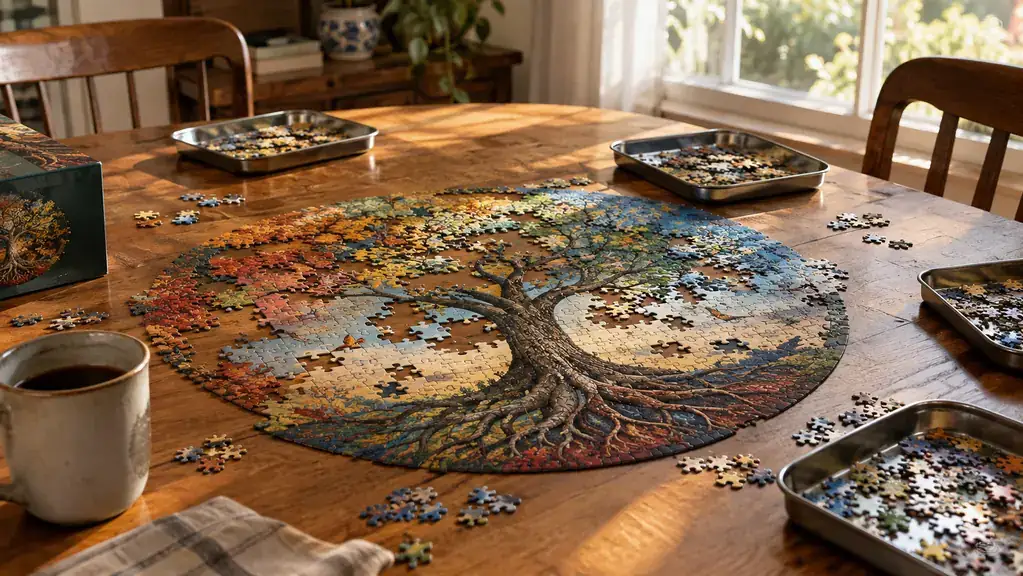
I have a simple rule for the puzzles that come into my house. If a new one does not get finished within a month, it goes back in the closet and I do not buy that brand again. So when the PICKFORU Tree of Life puzzle arrived last September, I did what I always do. I cleared the dining room table, dumped all 1000 pieces into a metal tray, and started sorting. Seven months later, that same table has hosted two complete builds of this puzzle, one solo and one with my twelve-year-old granddaughter, and the second one is framed and waiting for a wall in her room.
That is not something I can say about many puzzles. Most of the 1000-piece sets I get through end up half-built on a card table for a few weeks, then quietly get bagged back up. The Tree of Life is different, and the reasons are worth spelling out, because the difference between a puzzle you finish and a puzzle you abandon has very little to do with the picture on the box. It has to do with how the pieces fit, how the image guides you, and how the build feels at the two-hour mark when the novelty wears off.
The Quick Verdict
A genuinely challenging 1000-piece build with a stained glass look that is even better in person. It earned two full builds in my house, which is the highest compliment I can give a puzzle.
Amazon Check Today's Price →The Tree of Life puzzle that earned two full builds on my dining room table
If you want a 1000-piece challenge that looks like art when it is done, this is the one I keep recommending. Check today's price on Amazon and see if it fits your table.
Amazon Check Today's Price on Amazon →How I've Used It
First, the setup. I sort on the dining room table because it is the only surface in our house big enough for a 1000-piece build, and Gus knows not to move anything. I use four metal trays and a couple of old baking sheets, one for edges, one for the tree trunk and branches, one for the canopy, and one for what I call the background pile, which is the part that tests your patience.
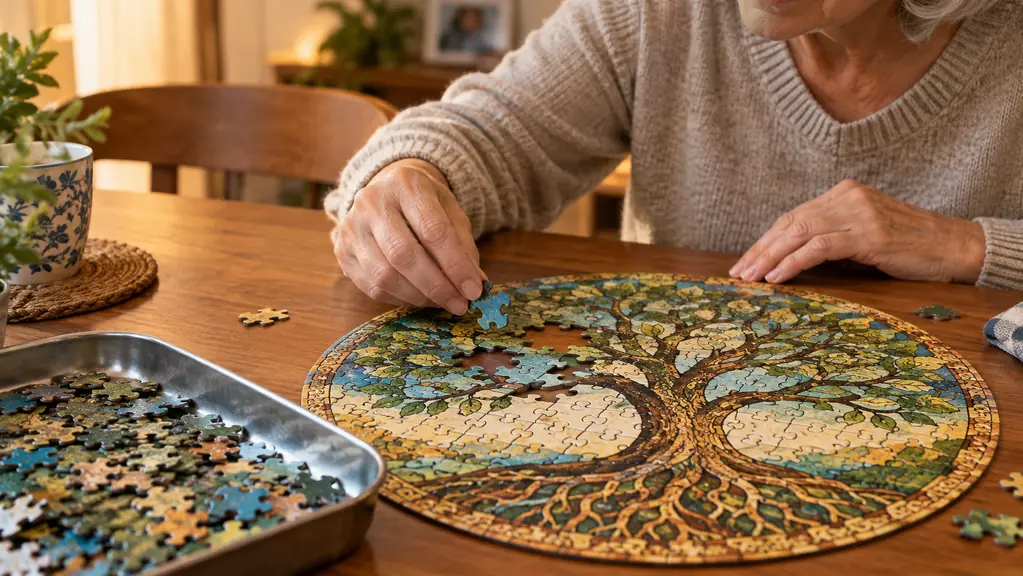
I built the first one solo over about a week and a half of evenings. I did not time it exactly, but I would guess somewhere around fifteen hours of actual puzzling, which for me makes it a genuinely hard 1000-piece build. The second build was faster because my granddaughter did a lot of the sorting and because we worked on it together over a long weekend plus a few afternoons. She finished the canopy section almost entirely on her own, which tells you the piece shapes are varied enough that a twelve-year-old can read them even when the tones are close. Gus is not a puzzler, but even he stopped to look at the finished tree before we framed it, which I took as a good sign.
One thing I did not expect is that this puzzle gets easier after the first few sessions, and then harder again near the end. The tree itself gives you strong landmarks, the trunk, the branches, the roots, so the middle of the build moves quickly. The last stretch, filling in the background around the canopy, is where the false fits show up and where you learn to trust the shape of the piece more than the picture on the box.
What Makes This Puzzle Different
The first thing you notice is the print quality. The stained glass style means the image is made of panels of color with dark lines between them, and on this puzzle those lines are crisp. That matters more than people think. A muddy print turns a 1000-piece puzzle into a guessing game. Here, the tree of life image stays readable even when you are looking at a tray of fifty similar-looking pieces.
The second thing is the piece variety. PICKFORU uses a mix of piece shapes, including some with fairly subtle tabs, which means you cannot build the whole thing by shape alone. You have to pay attention to the image. That is the difference between a puzzle that feels like work and a puzzle that feels like a puzzle. The variety also means fewer false fits than you would get with a cheap die that repeats every few rows.
Third, the finish. The pieces have a smooth finish, and the fit is snug without being so tight that you have to force pieces. That snug fit matters if you plan to frame it, because a puzzle that comes apart when you lift it is a puzzle you will never hang.
The Build: What 1000 Pieces Actually Feels Like
The honest description is that this is a challenging 1000-piece puzzle, not an impossible one. The product listing uses words like difficult and challenging, and for once those words are accurate. If you are an experienced puzzler, you will find it demanding but fair. If you are new to 1000-piece puzzles, this is not the one to start with.
Here is my sorting method, because it is the difference between enjoying this puzzle and fighting it. First, pull every edge piece and set them aside. Second, sort the rest into the tree pieces and the background pieces. Third, within the tree pile, sort by the big visual zones: the trunk, the branches, the roots, and the canopy. The canopy is the hardest zone because the panels blend into each other, so I sorted that pile by the direction of the dark lines. That one trick saved me hours. I also keep the edge pieces in a tray with a lid, because edges are the first thing to get lost when a table gets cleared for dinner.
The false fits are real but not outrageous. I would guess I placed maybe forty pieces wrong across both builds, and most of them were in the background sections where the image gives you very little to go on. The good news is that a wrong piece announces itself quickly, usually within two or three pieces, because the lines do not line up. You fix it, and you move on.
How It Looks Finished, and the Framing Question
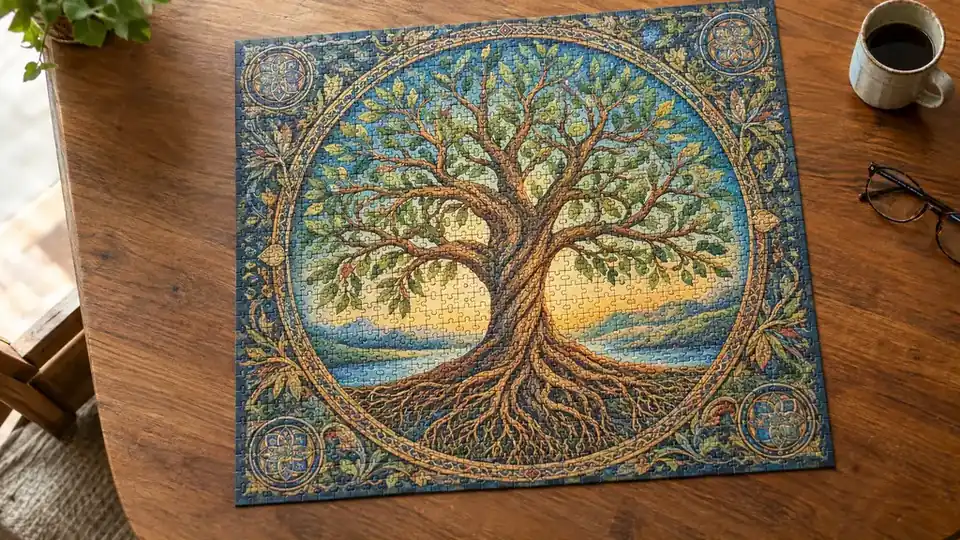
This is where the Tree of Life earns its keep. A finished stained glass style puzzle looks like a piece of art, not like a poster that got cut up. The mosaic panels catch the light differently depending on where you stand, which is something a photo on a listing cannot really convey. The finished size is the same as any 1000-piece set, but the image reads bigger, because your eye travels up the trunk and out along the branches. My granddaughter asked to keep the second one, and that is the first time any of the grandkids have claimed a finished puzzle for their own wall.
If you want to frame it, here is what I learned. Use puzzle glue you can paint on from the front, and give it a full twenty-four hours to dry before you try to lift it. Then slide a piece of cardboard under it and move it in one motion. This puzzle is sturdy enough to survive that, which is not true of every 1000-piece set. I have framed two of these now, and both came out flat and straight, which is the reason I keep recommending PICKFORU to friends who frame their finished work.
Grading It as a Gift
I buy a lot of puzzle and game gifts, and I judge every one by the same test. Is it still being used a month later? By that test, the Tree of Life is one of the best puzzle gifts I have bought in the past couple of years. It has the two things a puzzle gift needs. It looks impressive sitting on a table, and it is hard enough that the person who gets it feels a real sense of accomplishment when it is done.
It also has a wide age range. My twelve-year-old granddaughter could build large parts of it with help, and I would not hesitate to give it to an adult who likes a challenge. I gave one to a friend from my book club for her birthday, and she texted me a photo of the finished tree three weeks later, which is the closest thing to a review I trust. The one caveat is that it is not a social puzzle in the way a big, easy image is. The background sections are quiet, focused work. If you are buying it for a family to do together over the holidays, pair it with something easier for the kids, or expect the kids to handle the tree while the adults do the background.
The Fiddly Bits: What I Would Change
No puzzle is perfect, and this one has a few honest quirks. The background sections are the weakest part of the build. They are repetitive, the false fits cluster there, and if you are the kind of puzzler who needs every piece to feel interesting, you will hit a slow patch in the last few days. I handled it by saving the background for evenings when I wanted something mindless to do with my hands. It is not a flaw so much as a fact about this kind of image, but it is worth knowing before you start.
The other thing I would note is that this puzzle rewards a proper setup. You really do need sorting trays and a table you can leave alone for a week or two. Plan to do the sorting yourself, because the pieces do not come pre-sorted, and include a set of trays or a spare box lid if you give it as a gift. That one piece of preparation makes the difference between a gift that gets started the same night and a gift that sits in the closet until someone feels like sorting.
What I Liked
- Finished piece looks like art you would actually frame
- Crisp print and varied piece shapes keep the middle of the build interesting
- Genuine challenge without feeling unfair
- Held up through two full builds, including one led by a twelve-year-old
- Strong gift pick for adult puzzlers who already build regularly
Where It Falls Short
- Background sections are tedious, with the most false fits
- Not the puzzle to buy for a first-time 1000-piece builder
- Requires sorting and a table you can leave alone for a week or two
- The stylized stained glass look is not for anyone who prefers photographic scenes
Across two full builds, I placed maybe forty pieces wrong, almost all of them in the background, and it still came together flat enough to frame.
Who This Is For
This puzzle is for the puzzler who wants a project, not a quick afternoon. If you like a 1000-piece build that takes over your dining room table for a couple of weeks and rewards you with something worth framing, this is a strong pick. It is also a great gift for the person in your life who already does puzzles regularly and complains that most of them are too easy.
It is especially good for people who like art and puzzles in equal measure. The tree of life is a popular image for a reason, and the stained glass rendering gives you something to look at while you work. If you know someone who frames their finished puzzles, put this near the top of your list.
Who Should Skip It
If you are new to 1000-piece puzzles, skip this one for now. Start with something with a clear, high-contrast image and work up to it. The background sections of this puzzle will frustrate a beginner, and I have seen too many people give up on puzzling entirely because they picked a hard puzzle too early.
Skip it, too, if you hate sorting, because this puzzle demands it. You can technically dump all 1000 pieces into one pile, but you will spend most of your time hunting for pieces instead of placing them. And if you prefer photographic or scenic puzzles, the stylized stained glass look may not be your taste. There is nothing wrong with that. It is just a different kind of puzzle.
Still deciding? This is the puzzle I keep recommending to adult puzzlers
The Tree of Life has earned two full builds on my table and a spot on my granddaughter's wall. That is the best track record of any puzzle I have bought in the last two years. Check today's price on Amazon and see if it is a fit for your table.
Amazon Check Today's Price on Amazon →