
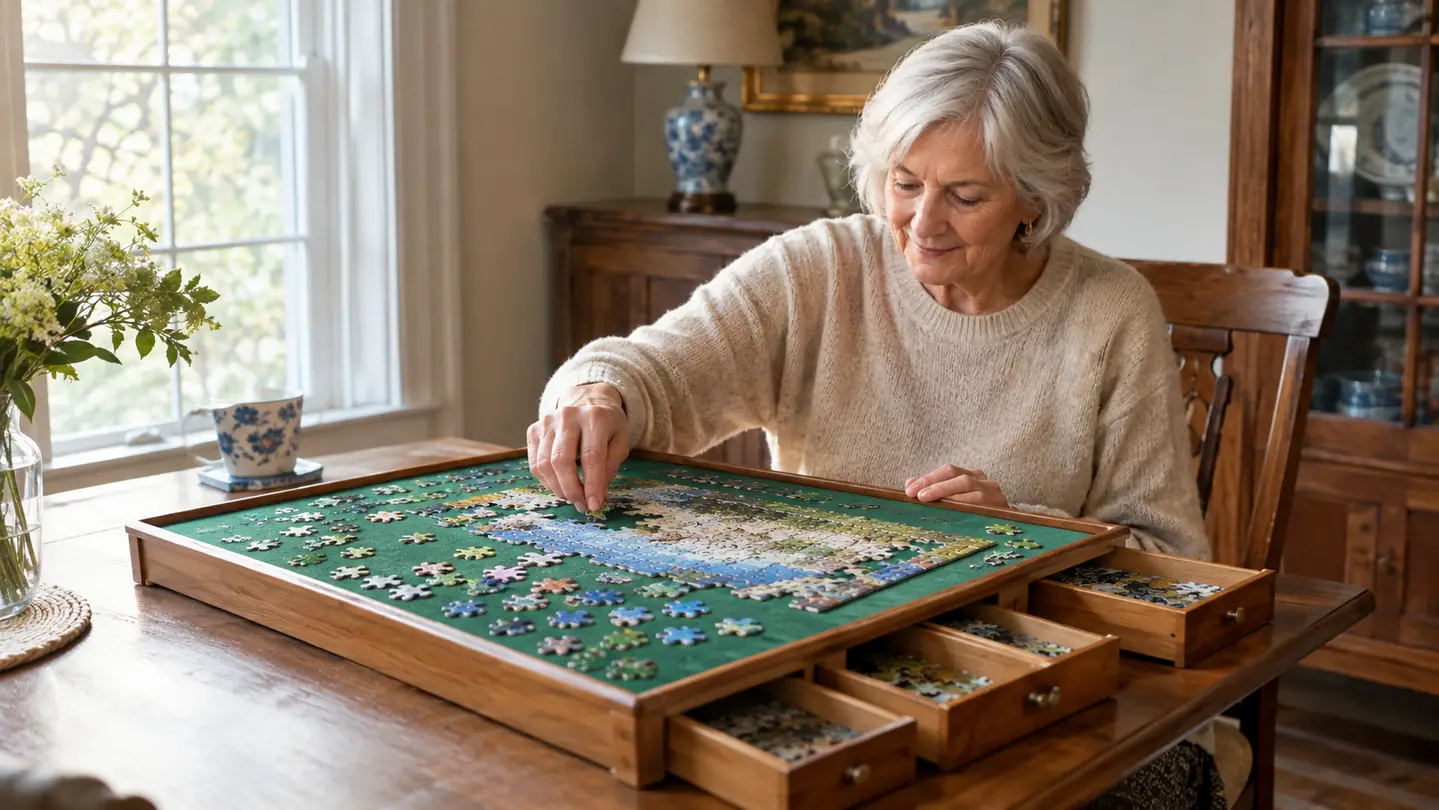
I have a simple rule for the gifts I buy, and it comes from thirty years of teaching middle school math: if it is not being used a month later, it was a bad gift. By that standard, the Bits and Pieces Original Puzzle Board with Drawers, XL 1500 Piece, has already passed. My husband Gus bought it for me in February, partly because I am always complaining about clearing the jigsaw off the dining room table before dinner, and partly because he was tired of eating around a half-finished puzzle of the Blue Ridge Mountains.
I have now used this board nearly every day for six weeks, through one complete 1,500-piece project and the start of a second one. This is the honest review I wish someone had written before I bought it, the one that tells you not just what it does well, but who should not buy it. So here is the short version first: the board is excellent at its one job, and its one job is narrower than the listing makes it sound.
The Quick Verdict
A sturdy board that genuinely holds a full 1,500-piece project, keeps the dining table usable, and has drawers that work as promised. It is also large and fairly heavy, so it is not a travel board, and it only earns its place if you have the room to leave it set up.
Amazon Check Today's Price →Keep the Dining Table Usable Mid-Puzzle
If you are tired of clearing a half-finished puzzle every time someone needs to eat, this is the board I reached for every day for six weeks. It holds the full project, keeps the pieces sorted in its drawers, and lets the project wait out dinner without being torn apart.
Amazon Check Today's Price on Amazon →How I've Used It
Setup took Gus about two minutes, which mostly meant taking it out of the box and running each drawer in and out to make sure it slid smoothly. The working surface is a felt board, and the frame is solid enough that I never once felt the whole thing flex while I was pressing pieces into place. My first project was a 1,500-piece landscape, and I sorted the edge pieces into the first drawer, the sky into the second, and everything green into the third before I even started the border.
What surprised me was how much the board changed the way I puzzle. Instead of working around the edge of the table and constantly sliding the project out of the way, I could pull the board toward me, turn it so the section I was working on faced me, and leave the pieces exactly where I had sorted them. Dinner no longer meant a twenty-minute teardown. When the table is needed, Gus and I lift the board together and set it on the sideboard, and the whole puzzle stays put.
Now for the part that nobody tells you, and the reason I am writing this review at all. The listing photographs make the board look tidy and manageable. It is not small. It is XL for a reason, and before you buy one you should measure the space where it will live, because this board will take over that space the way a card table does at Thanksgiving.
What Nobody Tells You About the Size
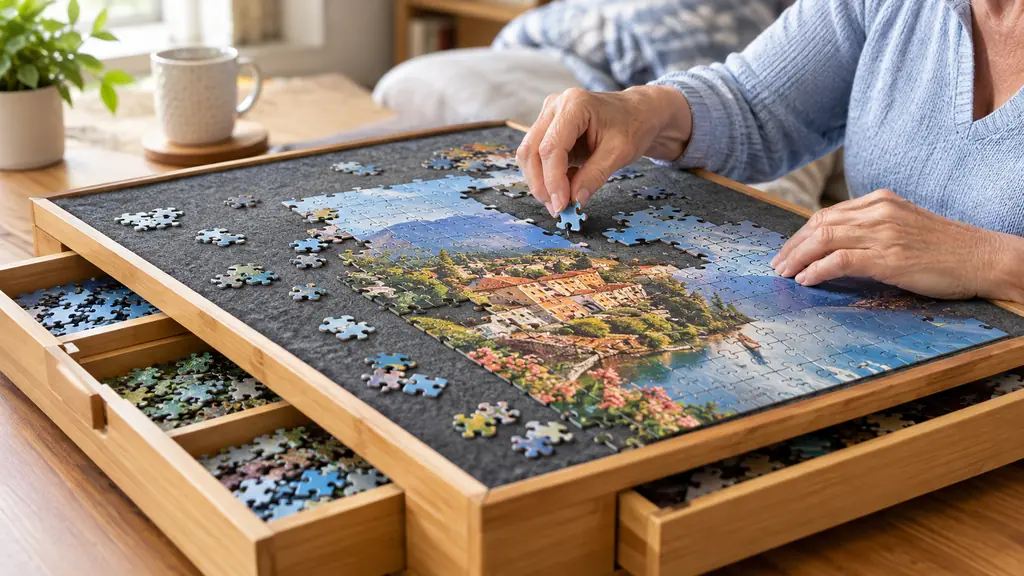
Let me be specific, because specific is the only useful kind of honest. A 1,500-piece puzzle measures roughly two feet by three feet when finished. The board that holds it is larger than that, with a border of frame around the surface and the drawers tucked along the sides. On my dining table, which seats six, the open board covers nearly the whole top. We eat at the kitchen counter when a project is in progress.
If you are shopping for this board sight unseen, do what I did not do and measure first. Measure the table, measure the floor space next to it, and measure the sideboard or counter where the board will wait out a meal. The listing says XL, and XL is not a suggestion. I cleared the top of our sideboard for it, and it fits, but it took some rearranging.
That sounds like a warning, and in one sense it is. But it is also the thing I came to love about the board. Because the puzzle has a permanent home, I stopped rushing to finish it. I could do forty minutes before the grandkids arrived, come back the next morning, and the project was exactly where I left it. For a person who likes slow, deliberate puzzling, that is the whole point.
The Drawers Do More Than You Expect, and Less
The drawers are the feature that sold Gus on this board, and after six weeks I agree with him. They slide out smoothly, they are wide enough to hold a serious color sort, and they keep the pieces off the table where they used to get mixed in with the day's mail. I keep the border pieces in one drawer, the sky in another, and the dark pieces in the third, and I have never once lost a piece to the floor.
The honest caveat is that the drawers are not deep. If you are the kind of puzzler who sorts every color into its own neat pile, you will run out of drawer space before you run out of puzzle. I learned to sort by large groups, sky, water, dark, bright, and let the fine sorting happen on the board itself. That is a small adjustment, but it is a real one.
The other thing the drawers do well is get the board cleared in a hurry. When the grandkids come over and the table needs to be free for a meal, I can sweep the loose pieces into the drawers by color group, and Gus and I can have the board on the sideboard in under two minutes. That speed is the difference between a board that gets used and one that gets abandoned.
The Felt Is the Feature Nobody Mentions
The listing talks about the drawers, of course, but the photographs do not show you what the felt surface actually does. I am sixty-one, and after a lifetime of puzzling on bare wooden tables I have opinions about how pieces behave under my fingers. On bare wood, pieces skate when you brush past them. On this felt, they stay where you set them, and I can sweep my hand across a sorted area without scattering a single row.
The thing nobody tells you is that the felt changes how you work. Because pieces grip instead of slide, I can sort directly on the board in loose rows and come back to them days later. The felt on this board is good, but it is not magic. If you bump the frame hard, a piece near the edge can still shift. I learned to keep loose pieces in the drawers rather than along the edge, and to slide the board level, never tip it, whenever Gus and I move it.
The felt also makes the board nicer to look at from across the room, which sounds like a small thing until you live with it. Against the felt, the finished sections stand out the way a photograph does on a mat, and the dining room looks like it has an art piece in progress instead of a mess on the table. Gus noticed it before I did, and he is not a puzzler.
What This Board Is Not
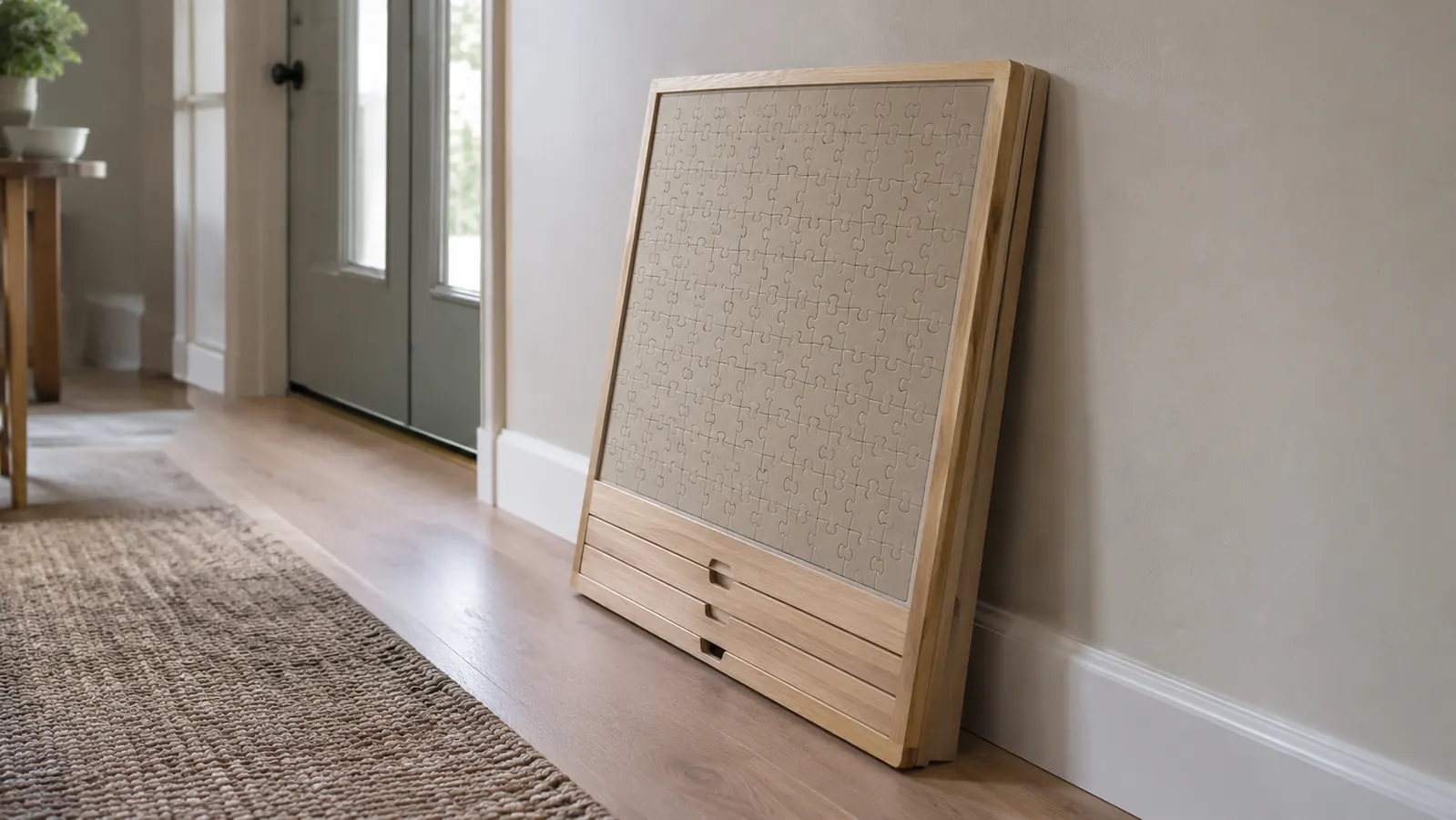
Here is where I have to be the honest reviewer and not the enthusiastic one. The Bits and Pieces Original Puzzle Board with Drawers is not a travel board, it is not a storage case, and it is not a cure for a house that has no space to spare. It is a piece of furniture that lives in one room. You can carry it to another room now and then, but it is not something you will want to haul around every evening.
It is also not a board you will move around much. The XL size that makes it useful for a 1,500-piece project also makes it heavy. I rarely carry it. Usually Gus and I move it together when we need to vacuum, and that is most of the exercise it gets. If you want to puzzle in three different rooms depending on your mood, this is the wrong tool and a simple puzzle mat will serve you better.
One more honest note, and I say this as someone who has bought puzzle gifts for every member of my family. This board is a gift for a specific kind of person, the puzzler who already has a project going and a place to put it. For that person it is the gift that keeps the table clear. For a casual puzzler, it is a large object that will end up in the closet by March.
If you are comparing this board to a puzzle mat, the honest difference is simple. A mat rolls up and moves with you, which suits short sessions in different rooms. A board like this gives you a stable surface and real drawers, which suits long projects. For the kind of slow puzzling I actually do, the board wins.
How It Holds Up Week After Week
The honest question for any puzzle board is whether it still works the way it did on day one, and after six weeks of daily use this one does. The drawers still slide smoothly, the felt still grips the pieces, and the frame has not warped or started to separate at the corners. Gus and I have lifted the board from the dining table to the sideboard and back at least a dozen times, and nothing has loosened.
I will also tell you what I look for in a board, because I have tried cheaper ones that fell apart in a month. The frame on the Bits and Pieces board is genuinely solid. There is no flex in the middle when I press down on a stubborn piece, no rocking on the table, and the drawer tracks have not started to stick. For the money, that is exactly what I want to hear.
I also want to say something about the finish, because it is the detail that separates a well-made board from a cheap one. After six weeks of daily use, there are no rough edges, no sticky drawer tracks, and no marks on the dining table where the board sits. The felt has not pilled or worn thin where I rest my hands. Those are the small things that tell you a product was designed by people who actually use it.
One small warning about the felt surface, because it is the kind of thing that only shows up after weeks of use. If you park the board on a sideboard between sessions, keep it clear of radiators and strong afternoon sun. The felt is durable, but it is still fabric, and I have started draping a light cloth over the board when the house is empty. It is not a flaw, just a habit you pick up with any piece of furniture you care about.
What I Liked
- Holds a full 1,500-piece puzzle with room to spare
- Smooth drawers keep color sorts off the table
- Felt surface keeps pieces from skating out of place
- Lifts off the table in one piece when two people move it
- Sturdy frame with no wobble and no flex while working
Where It Falls Short
- Large footprint takes over the dining room while set up
- Drawers are shallow for aggressive sorters
- Heavy enough that moving it is a two-handed job
- A hard bump can still shift pieces near the edge
Six weeks in, the 1,500-piece puzzle is still on the board, the dining table is still clear at dinner, and I have not lost a single piece to the floor. That is the whole review in one sentence.
Who This Is For
Buy this board for the person who has a puzzle permanently in progress and a table they are willing to dedicate to it. That is the puzzle lover who leaves the project out for days, sorts pieces into coffee cans, and sighs every time they have to clear the table for a meal. For that person, the Bits and Pieces board is not a luxury. It is the difference between finishing a 1,500-piece project and abandoning it halfway through.
The board also suits a specific style of puzzling, the kind where you work from the border inward and let a project live for a week or more. If you are a speed puzzler who finishes 1,000 pieces in an evening, the drawers and the felt will not hurt you, but you will not need them either. This board rewards the slow, steady puzzler who enjoys the process as much as the finished picture.
I buy a lot of puzzle and game gifts, and I judge every one of them by the same standard: is it still being used a month later? By that measure, this board is one of the better purchases I have made. Two friends from my book club saw it at game night and asked for the link before they left. One of them has already ordered one. That kind of word of mouth is the only review I trust.
The caveat is that it is a gift for the recipient's habits, not a gift you hope will start a new hobby. If the person on your list already has a puzzle out on a table, this board will change their life in a small, quiet way. If they do not, buy them a 300-piece puzzle first and see whether they finish it.
Who Should Skip It
Skip it if you puzzle on the couch, on the bed, or in whatever corner of the house has the best light that day. Skip it if your puzzle sessions happen once a month and never last longer than an hour. Skip it if you live in a small apartment where a board this size has no permanent home. And skip it if what you actually want is a way to tuck a puzzle under the bed, because that is a different product entirely.
I also would not buy it for a child, at least not as a first puzzle board. The XL size is built for adult projects, and a ten-year-old will not get much use out of a board that holds 1,500 pieces when their current puzzle has 300. There are smaller boards that fit a child's table better, and that is the honest recommendation I would give my own grandkids' parents.
One more group belongs on the skip list, and it is the person who does most of their puzzling on a tablet or a phone. If your idea of a relaxing evening is a digital jigsaw with no pieces to lose, a physical board of this size will feel like a step backward. Buy them a puzzle book instead and save the board for someone who still likes the feel of cardboard in their hands.
Still Set Up in My Dining Room After Six Weeks
I have bought a lot of puzzle gifts over the years and most of them end up in the closet. This board is still in daily use, with a 1,500-piece project on it and the table clear at dinner. If that describes the puzzler you are shopping for, this is a safe buy.
Amazon Check Today's Price on Amazon →