

The first time I picked up a metal disentanglement puzzle, I did the one thing you are never supposed to do with them. I pulled hard on both ends and tried to muscle the pieces apart. It did not work. The wire flexed a little, the two pieces stayed locked together, and I felt exactly as foolish as I looked. That was a few years ago, before I learned that these puzzles are not about strength at all. They are about seeing where the pieces actually touch, and that is a skill you can learn in an evening with the right set. The Coogam Metal Wire Puzzle Set of 16 is the set that taught me, and it is the one I now buy for anyone who likes a good brain teaser. Every puzzle in the set has taught me something, and the hardest ones taught me the most.
Why am I writing this out step by step? Because most of the advice you will find about these puzzles is either a spoiler for one specific puzzle or a vague 'just think about it' that helps no one. If you are buying a set for a kid, a grandparent, or a friend who has never tried one, the difference between a fun first evening and a frustrating one is usually just knowing where to start. This is the walkthrough I would give a friend across my kitchen table, the same one I use when the grandkids come over and one of them picks up a puzzle and asks me to show them how it works.
Start with the easy ones. The set gives you sixteen chances to get hooked.
The Coogam set comes with 16 metal puzzles and a small pouch to keep them together. It is the set I keep on the coffee table, and the one I buy as a gift when I want something that will actually get played with a month later. Check today's price on Amazon before you decide.
Amazon Check Today's Price on Amazon →Step 1: Pick Your First Puzzle on Purpose
The biggest mistake I see is people grabbing the most complicated-looking puzzle first. The Coogam set has 16 puzzles, and they are not all the same difficulty. A few are simple two-piece rings that come apart in two moves. A few, like the Chinese ring style puzzles, will take a beginner a long while. Start with the simplest one that catches your eye, and save the rest for later. There is no shame in working them in order of how hard they look.
How do you tell which is easiest? Look for puzzles where the pieces are mostly straight, with a single curve or loop at the end. Those separate with one or two moves. Puzzles with multiple interlocking loops, or with a long straight piece threaded through several rings, are the ones that will test you. Sort them into a 'start here' pile and a 'later' pile before you begin. That ten seconds of sorting saves an hour of frustration later.
One more thing about the order. If you are giving this set to a child, let them pick their own first puzzle, even if it is a hard one. The lesson lands better when they choose it themselves. Just be ready to sit with them when the hard one wins, because it will, and that is fine. The struggle is the point.
Step 2: Learn the Two Moves That Solve Most of These
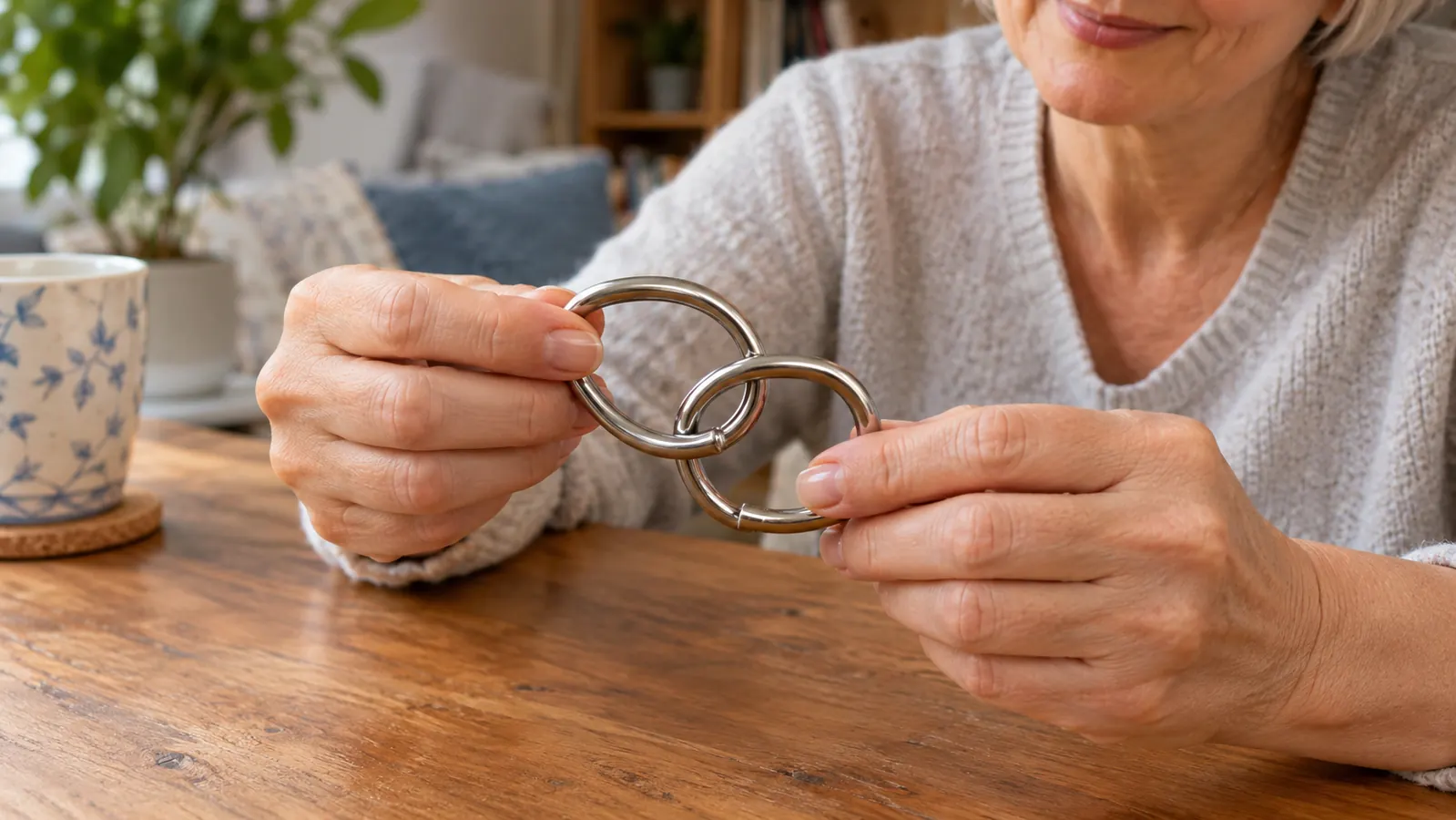
Nearly every puzzle in a set like this comes down to two moves. The first is the loop over. You find a spot where one piece can pass over or under another piece, usually at an angle, and you thread it through at exactly that angle. The second is the twist and slide. You rotate one piece while it is inside the other, then slide it through a gap that did not look big enough. That is it. Most of the 16 puzzles are variations on those two ideas, and once you can do both without thinking, you can solve most of the set.
Here is the part I wish someone had told me on day one: the goal is to separate the pieces without bending them. If you have to force it, you are doing it wrong. The wire is sturdy, and a little flex is normal, but a puzzle that suddenly comes apart with a snap usually came apart because you bent it. Ease off, look again, and try the move at a slightly different angle. The right angle always feels like it takes no effort at all.
When I taught middle school, I used to tell my students that math problems never look hard once you know the move. These puzzles are the same. The first time you do the loop over, it feels like a small triumph. The tenth time, it feels like second nature. That is the whole appeal of a good puzzle set: you get to feel that shift over and over.
Step 3: Work the Puzzle in a Quiet Spot, Not in Front of the TV
These puzzles ask for a different kind of attention than a jigsaw, which is why I like them. With a jigsaw I can chat and sort pieces at the same time. With a metal puzzle, the moment I look away, I lose the angle I was working. I keep a small basket by the armchair in the living room, and I do my puzzles in the twenty quiet minutes after Gus leaves for his morning walk, with coffee, before the day gets loud. The basket cost nothing, and it makes the puzzles feel like part of the room instead of a project.
If you are giving a set to a child, this matters even more. A kid who tries one of these while the TV is on will get frustrated in two minutes and toss it aside. A kid who tries it at the kitchen table, with an adult doing one alongside them, will usually stick with it for a surprisingly long time. My granddaughter, who is nine, sat for almost an hour with the two-ring puzzle until she got it. That is the best advertisement for these things I have.
The quiet spot does not have to be a silent room. It just has to be a place where nobody is going to interrupt for a few minutes. The back porch works. The kitchen counter while dinner simmers works. The car, if you are the passenger, works surprisingly well. What does not work is a puzzle in one hand and a phone in the other.

Step 4: When You Get Stuck, Change Your Reference Point
This is the math teacher in me talking, and it is the single most useful tip I have. When you are stuck, you are almost always stuck because you have been looking at the puzzle from the same angle for five minutes. Put it down, pick it up the other way, or turn it so the piece you have been staring at is now facing away from you. The move that was impossible from one side is often obvious from the other. I have watched grown adults sit with a puzzle upside down for ten minutes without thinking to flip it.
I also tell people to look at where the pieces touch, not at the pieces themselves. The answer to a disentanglement puzzle is always at the point of contact. If you can see exactly which two spots are touching, you can usually see which one needs to move first. That sentence has solved more puzzles for me than any trick I have ever read, and it is the one I repeat out loud when I am stuck.
There is a name for this in math class, though I will not use it here. The short version is that changing your point of view is a real problem-solving skill, and a set of wire puzzles is one of the cheapest ways I know to practice it. Every time you flip a puzzle over and suddenly see the answer, you are building that habit.
Step 5: Put It Back Together and Do It Again
Here is the part most people skip, and it is the part that actually builds the skill. Getting a puzzle apart is half the challenge. Putting it back together is the other half, and it is harder, because now you have to reverse the moves you just made. Do not toss the pieces back in the pouch and call it done. Sit with the reassembly for a few minutes. That is where the learning happens.
Once you can take a puzzle apart and put it back together without thinking, time yourself. The first time I did the two-ring puzzle, it took me close to ten minutes. By the third evening, I could do it in under a minute without looking. That kind of progress is deeply satisfying, and it is the reason these puzzles are still on my coffee table months later instead of in the back of a closet. My record on the two-ring puzzle is now eleven seconds, which my nine-year-old granddaughter refuses to believe.
The reassembly habit is also what makes the set last. Puzzles that get shoved apart and left in pieces tend to lose pieces. Puzzles that get taken apart and put back together stay complete, which matters when you are buying a set for a house with kids. A complete set is one that can be passed down to the next grandchild.
What Else Helps
A few small things make the whole set easier to live with. The pouch that comes with the Coogam set is genuinely useful. Keep it, because 16 loose metal puzzles will end up everywhere if you do not. Do one puzzle at a time and put the rest away. And if you are buying this as a gift, resist the urge to hand over all 16 at once. Giving a kid two or three puzzles at a time, with the rest saved for later, keeps the set feeling new for months. I have bought this set four times now, always as a gift, and it is the rare present that is still being played with a month later. The pouch also keeps the pieces from knocking against each other in a drawer, which matters more than it sounds.
One more note on gifting. A metal puzzle set looks like a small, simple present, and it is easy to underestimate. It is not a toy that gets opened and forgotten. It is an activity, and activities are what the grandkids actually remember. My oldest grandson, who is fifteen and hard to impress, still grabs the pouch when he comes over.
The first time I did the two-ring puzzle, it took me close to ten minutes. By the third evening, I could do it in under a minute without looking.
If you are still on the fence, here is my honest bottom line. These puzzles are not a cure for boredom, and they are not for everyone. But for a curious kid, a retired person who likes to keep their hands busy, or a friend who says they have everything, they are the gift that keeps showing up on the table. Start with step one, keep these steps handy, and give yourself permission to be slow. Slow is how the solving happens. And if you get stuck, come back tomorrow. The puzzle will still be there, and so will the answer.
The set that keeps getting picked up, not put away.
Sixteen puzzles, a pouch to keep them together, and a difficulty range that works for ages 6 to 86. It is the gift I keep buying, and the one I keep on my own coffee table. Check today's price on Amazon and see if it is the right fit for your family.
Amazon Check Today's Price on Amazon →