
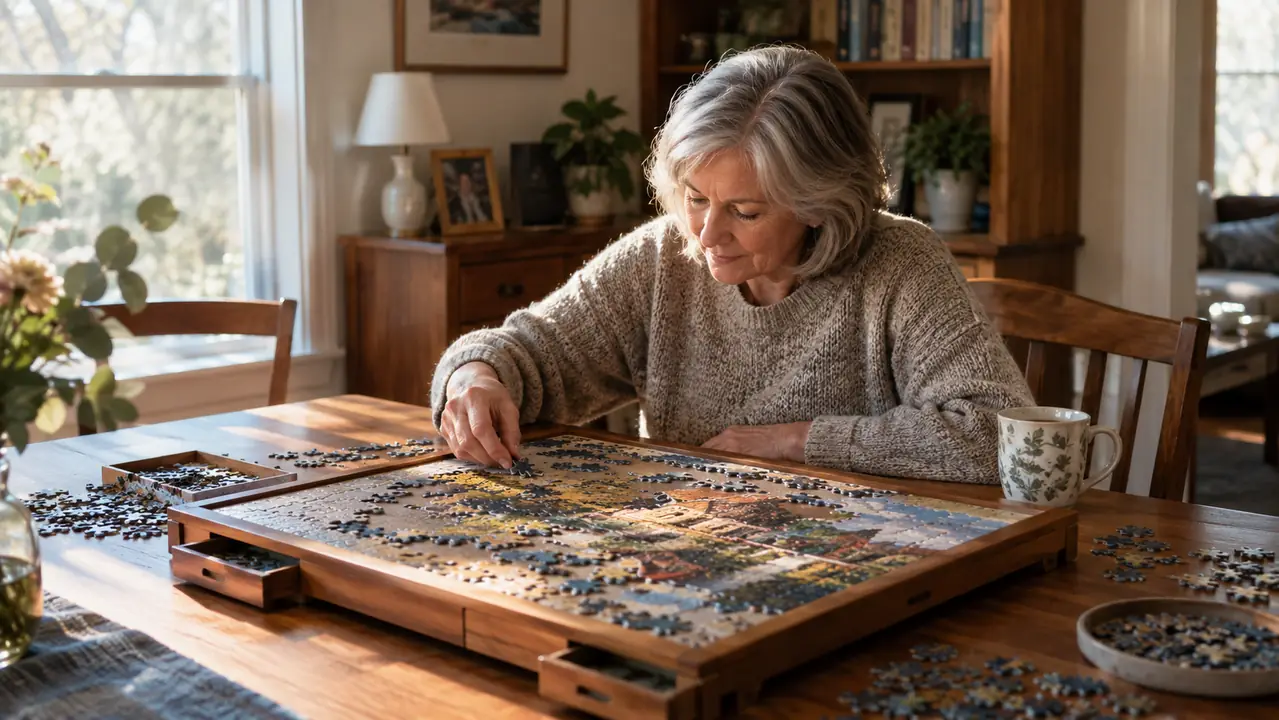
Every puzzler I know has lost a piece. Not misplaced for an evening, but gone, swept into the void between the couch cushion and the wall, or into the vacuum bag, or under the pile of mail that lives on the sideboard. I've finished a 1,000 piece puzzle with a hole the size of a thumbnail in the middle of the lighthouse, and I've also found that missing piece three months later inside a book I hadn't opened since Christmas. If you're a puzzle lover, or you're shopping for one, the sorting and storing part matters as much as the picture on the box.
That's why I finally bought the Bits and Pieces puzzle board with drawers. It's the XL 1500 piece version, and it's lived on my dining room table in Asheville since March. It's survived five grandkids ages 6 to 15, a holiday season, and more game nights with my book club than I can count. This article is the plain-talk version of how I sort and store pieces on it, step by step, so no piece ends up in the vacuum bag.
I've tried every other way of keeping pieces together. Zippered bags work until you need a piece from three bags ago. Cardboard boxes work until they get stacked and forgotten. A puzzle mat rolls the puzzle up, but it doesn't help you sort, and rolling a half-finished 1,500 piece puzzle is a gamble I stopped taking. The board with drawers is the first system that handled both jobs, sorting and storing, without any extra equipment.
Stop losing pieces to the dining room table.
The Bits and Pieces XL board with drawers gives you sorting trays and storage in one place, and it fits a 1,500 piece puzzle with room to work. It is the board that ended my lost-piece streak.
Amazon Check Today's Price on Amazon →Step 1: Set Up Your Sorting Station Before You Open the Bag
Before I pour out a single piece, I set up the space. The board goes on the dining room table, flat and centered, with the drawers facing me. I clear everything else off the table, because a puzzle that has to share the surface with mail and grocery bags is a puzzle that loses pieces. Good light matters too. I use a daylight lamp on gloomy afternoons, and I've learned that sorting 1,500 pieces in bad light is how pieces end up in the wrong drawer. The XL board fits a 1,500 piece puzzle with room to spare, which matters more than it sounds like.
The drawers are the part I didn't expect to love. They've become my sorting trays, which means I don't need a separate set of cups or boxes cluttering the table. When I'm done for the night, the drawers close and the sorting work is saved. That one feature, drawers that close, is worth more than any fancy surface. I keep one drawer empty for pieces I find on the floor, because with five grandkids in and out, pieces migrate.
One more setup step: I keep a small bowl on the table for pieces I am not sure about yet. Mystery pieces go in the bowl, not in a drawer, so they do not get buried. At the end of a session I deal with the bowl, and the board stays tidy.
Step 2: Turn Every Piece Face Up Before You Sort Anything
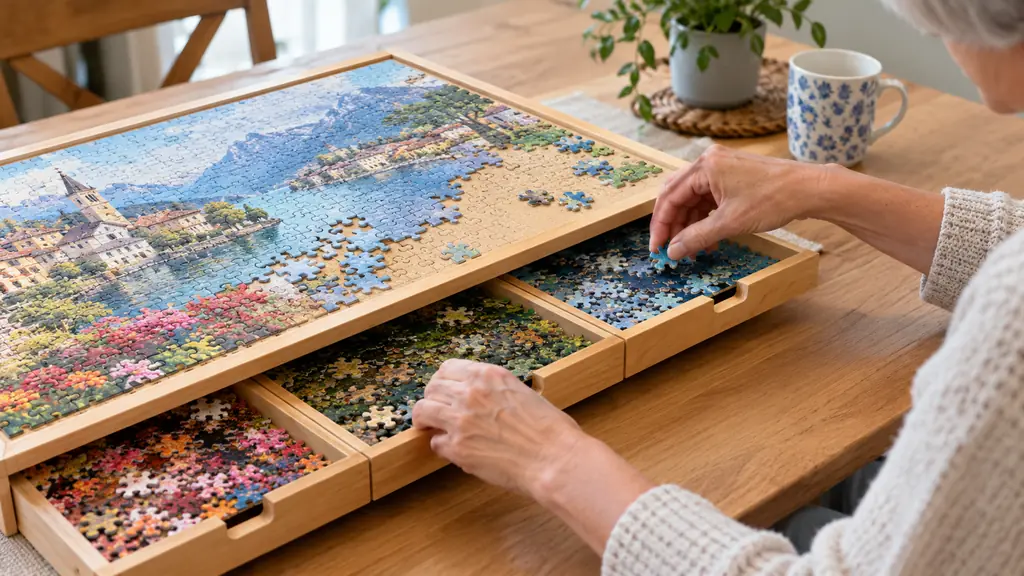
The most tedious part of any big puzzle is the flip. With 1,500 pieces, I pour out about a quarter of the bag at a time, spread the pieces in a single layer on the board, and turn each one so the picture side is up. I pour in batches because a full bag dumped at once becomes a mountain, and a mountain hides pieces. Flipping in batches keeps the pile small enough to manage and gives my eyes a rest between rounds. I set a kitchen timer for fifteen minutes, and when it dings I stand up, stretch, and start the next batch.
People skip this step because it feels like wasted time, and then they wonder why sorting takes all afternoon. A piece that is face down tells you nothing. A piece that is face up can be sorted in a glance. The flip is the boring ten minutes that saves you forty. The timer also keeps me honest. Without it, I'd spend an hour flipping and none solving.
I do the flipping right on the board because it keeps everything in one contained area. Nothing slides off the edge, nothing gets swept onto the floor, and the pieces stay in the order I poured them, which matters more than you would think. It also means the pieces stay clean, which matters more than I expected.
Step 3: Pull Every Edge Piece Before You Color Sort
The frame is the fastest win in any puzzle. I pick out every piece with at least one straight edge and lay the corners in a small row at the top of the board. I lay the straight pieces along the inside edge of the board, where they're out of the way but still in sight. With the XL board there's plenty of room to build the frame as I go, and the frame gives me the boundaries of the picture. Building the border first means the last night of the puzzle is about the fun parts, not about hunting for a sky piece.
Edges first also answers the question every puzzler dreads: is a piece missing? If a straight edge is missing, I want to know on day one, while I can still order a replacement or exchange the puzzle, not on the final night when I'm staring at a hole. I sort the edge pieces into small piles by shape: corners, flat side on the left, flat side on the right, flat side on top, flat side on the bottom. That sounds fussy, but the frame then goes together in minutes.
If you are doing this with a child, the edge hunt is the best job to hand them. Straight edges are easy to spot, and every piece they find is a small victory. My youngest grandkid, age 6, has sorted the frame of every puzzle we have done together since she could reach the table. It is also the job I give visiting adults who want to help but do not want to commit to a puzzle.
Step 4: Color Sort the Rest Into the Drawers
This is where the drawers earn their keep. I sort by the dominant color or pattern: sky, water, trees, brick, text, and one drawer for mystery pieces I can't place yet. I name the drawers out loud as I go, which sounds silly, but it keeps me from re-sorting the same piece twice. For a 1,500 piece puzzle, six to eight piles is plenty. If you sort into twenty piles, you spend more time sorting than solving. The goal is to narrow the search, not to hand yourself every piece in order.
One trick from my teaching days: sort the hardest color first. For most puzzles that is the sky or a large area of a single color. When that drawer is done, the rest of the puzzle feels easy. I also keep pieces with writing or numbers together, because text pieces are easier to place than they look, and they are a gift when you are stuck.
I put the drawers back in the board as I fill them, so the whole puzzle lives in one place. When I need the table for dinner, I close the drawers, and the sorting work is exactly where I left it. That's the quiet luxury of a board with drawers: the work is never lost, and it's never in the way. On nights when Gus is watching a game and I'm not interested, I can pull the board over and work for twenty minutes without turning on another light.
Step 5: Store It Between Sessions So the Work Is Never Lost
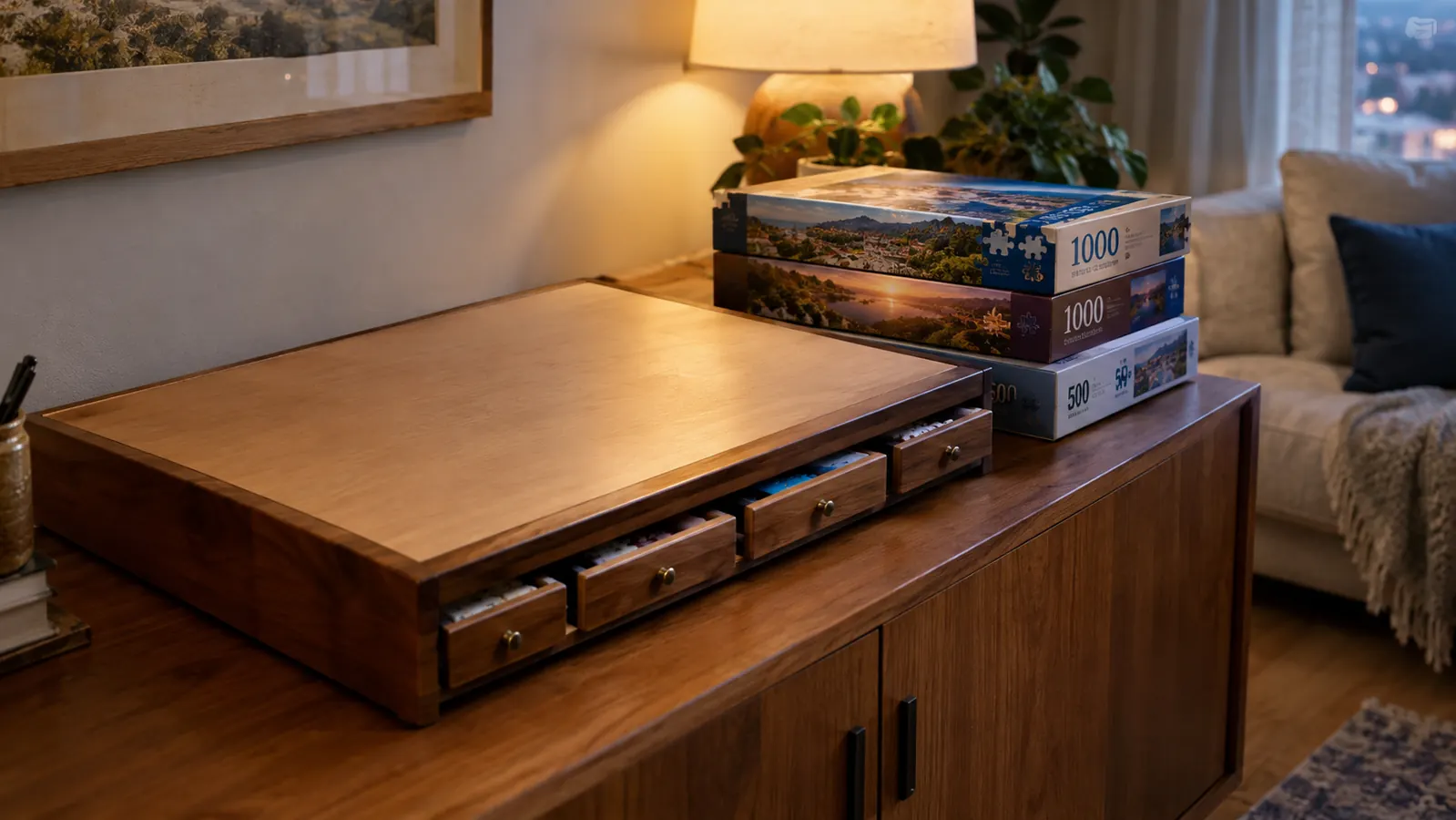
The real test of any puzzle setup is what happens when dinner needs the table. With the Bits and Pieces board, I close the drawers, and if I need the whole table, I move the board, drawers closed, to the sideboard. I've carried the board from the dining room to the sideboard more times than I can count, and I've never lost a piece in the move. The sorted pieces stay in their drawers, and the in-progress section stays on the board. When I'm ready to puzzle again, I carry it back, open the drawers, and pick up exactly where I left off.
When I finish a puzzle, I take a photo for the family group chat, then I take the puzzle apart in sections and sort the pieces back into the box. The drawers make the take-apart easy, because I can sort as I go instead of dumping everything into one pile. For the grandkids' puzzles, the rule is the same: pieces in the drawers, board closed, and the puzzle survives until the next visit. I keep the box with the board, so the reference picture is always close.
A puzzle that has to be rebuilt from scratch every time is a puzzle that stops getting finished. That is the honest reason I bought this board. It is not about having a fancy table. It is about making sure the work you did last Tuesday is still there on Thursday. That is also why I buy this board for other people. It fixes the exact reason most puzzles in my house used to go unfinished.
What Else Helps
A few things I use alongside the board. I keep a large zippered bag for pieces when a grandkid wants to take a puzzle to their house, and I always put the box lid or a photo of the finished image nearby, because I puzzle better when I can see what I'm aiming for. The zippered bag is also where I keep the pieces of a puzzle I'm saving for a rainy day, so they don't get mixed into the current one. I also have a second small tray for a 500 piece puzzle, because sometimes I want a quick puzzle while my 1,500 piece waits. And I have one hard rule: no open drinks on the table. A spilled glass of tea has ended more puzzles than any missing piece.
If you're shopping for this as a gift, the drawers are the feature that matters. A puzzle mat rolls a puzzle up, but it doesn't give you sorting trays, and it doesn't protect the work in progress the way a board with drawers does. I've bought puzzle gifts that ended up in the closet, and I've bought puzzle gifts that are still on the table. This board is the second kind. My book club friends have asked about it twice, and both times I told them the same thing: the drawers are the whole point.
One more honest note. A board does not sort the pieces for you, and it does not finish the puzzle. You still have to do the work. What it does is remove every excuse for not doing the work: the table is needed, the pieces would get mixed up, the sorting would be lost. When the setup is this easy, the puzzle actually gets finished, and that is the whole point of buying one. If you are buying for someone who says they like puzzles but never seems to finish one, this is the gift that removes the excuse.
I have not lost a single piece since March, and that includes a holiday season with five grandkids in the house.
Give the puzzle lover in your life a board that keeps every piece.
The Bits and Pieces XL board with drawers sorts, stores, and protects any puzzle in progress, up to 1,500 pieces. Check today's price on Amazon.
Amazon Check Today's Price on Amazon →