
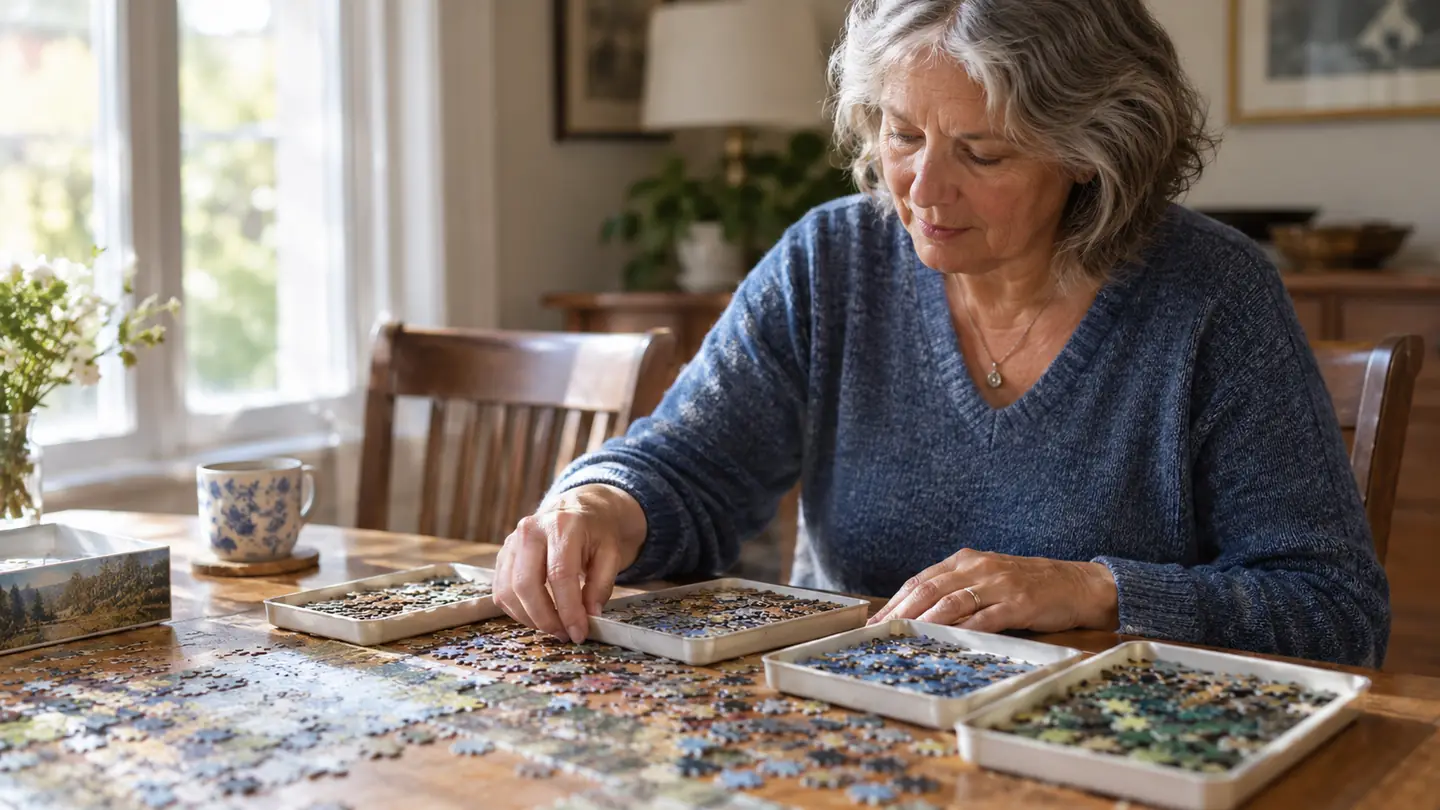
Every puzzle starts the same way: you dump out the box, and a thousand pieces stare back at you. If you are new to 1000-piece puzzles, that first ten minutes can feel like the hardest part. I have been putting puzzles together since I was a kid, and I still use the same method every time. It works for a colorful mosaic like the PICKFORU Tree of Life, and it works for a moody landscape where every piece looks like every other piece. Here is how to start a jigsaw puzzle without losing your nerve.
I am Roz, a retired middle-school math teacher in Asheville, North Carolina. There is always a puzzle in progress on my dining room table, and I have bought enough puzzle gifts over the years to know which ones actually get finished. The PICKFORU Tree of Life is one I keep coming back to, so I will use it as the working example for the method below.
Start with a puzzle that rewards the method
The PICKFORU Tree of Life is a hard puzzle, but once the border is built, its distinct color zones give you a real place to start, which is exactly what this method needs. Check today's price on Amazon before you start.
Amazon Check Today's Price on Amazon →Step 1: Set up your workspace before you open the box
The single biggest mistake I see with new puzzlers is starting on a surface that is too small. A 1000-piece puzzle needs room for the finished image, plus space to sort pieces into groups. I use a folding puzzle board that slides under the couch, but a large piece of cardboard or a spare table works fine. You want enough room that you are not stacking pieces on top of each other.
Gather a few small trays or lids before you dump the box. I use the lids from takeout containers, and I keep a stack of them in the puzzle drawer. You will also want good light. The PICKFORU Tree of Life has a lot of rich color, and sorting those colors is much easier in daylight than under a dim lamp. Last fall I started a puzzle at the kitchen table under the pendant light and spent a whole evening mis-sorting the dark leaves. The next morning I moved the board to the dining room window and the same pieces sorted themselves in twenty minutes. Light is not a nice-to-have, it is part of the setup.
One more thing: decide whether you are a sorter or a dumper. Some people like to dump all the pieces and hunt through the pile. I am a sorter. I find that sorting first saves time later, even though it feels slow at the start. If you are new to puzzles, sorting first will save you a lot of frustration. My rule of thumb is that the setup takes about as long as the first two sessions of puzzling, and that is time well spent.
Step 2: Find all the edge pieces first
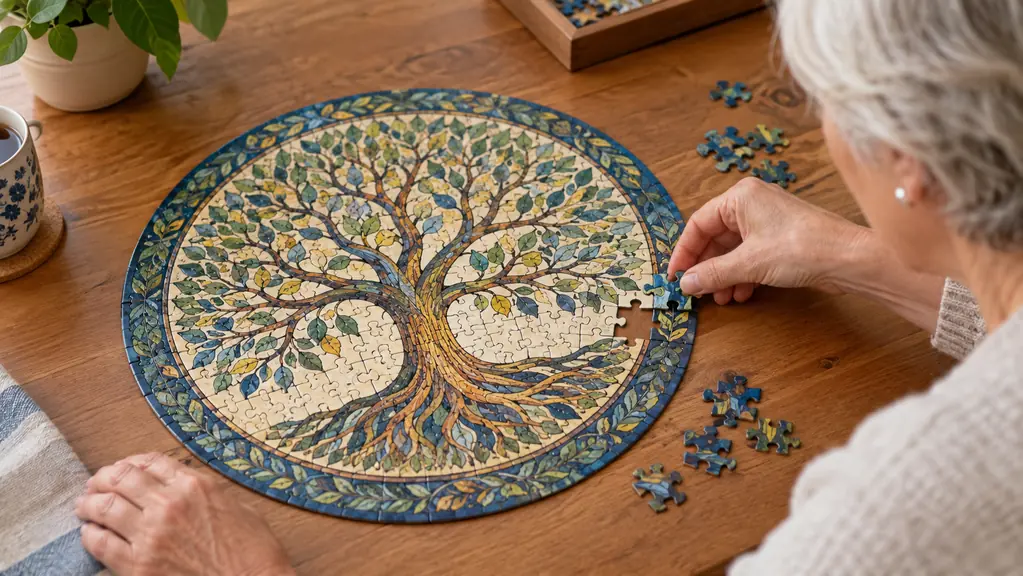
The border is your frame, and it is the easiest place to build momentum. Go through the box and pull out every piece with a straight edge. In a standard 1000-piece puzzle, that is usually around 120 pieces, give or take. Do not worry about the corners yet. Just get all the straight edges into one pile. When I counted the edge pieces on the PICKFORU Tree of Life, I got 124, which is right in the normal range.
With the PICKFORU Tree of Life, the border is harder than usual, because many edge pieces are dark and leafy and blend into the tree, so pull out every straight edge by feel rather than by color. That makes this step slower, but it matters even more on a puzzle like this one. Give it a full evening if you need to. Once the border is done, you have a real win, and that win carries you through the middle of the puzzle. I finished the whole frame in one sitting, which is rare for me on a first night.
Once you have the edge pieces, separate the corners. There should be four of them. Build the frame by working from the corners outward. I like to lay out the bottom edge first, then the sides, then the top. It does not matter which order you use, as long as you complete the frame before you move on. If a piece looks like an edge piece but will not fit anywhere, set it aside in a small tray rather than forcing it. Forcing pieces is how bent tabs happen.
Step 3: Sort by color and pattern, not by shape
New puzzlers often try to match pieces by their shape, looking for the piece with the right tabs and blanks. That is slow and frustrating. The faster way is to sort by color and pattern. The PICKFORU Tree of Life suits this first cut because the image breaks into broad zones: the tree trunk, the leaves, the branches, and the colorful mosaic background. On my first pass I used five trays: one for the trunk and branches, one for the green leaves, one for the warm gold and orange background, one for the cool blue and purple background, and one for everything I could not place yet.
I use one tray per color zone. The trunk pieces go in one tray, the green leaf pieces in another, the warm background pieces in a third, and so on. You do not need to be perfect. Just get each piece into a tray that feels close. You can refine the groups as you go. The pieces that do not fit any zone go into a catch-all tray, and I pull from that tray last.
Here is the math teacher in me: sorting is a classification problem, and the best classification rule is the one that splits your pieces into groups of roughly equal size. If one tray has two hundred pieces and another has ten, your sorting rule is not working. Adjust it. For a tree of life image, sorting by color zone is a good first cut because each zone is big enough to be useful, though inside each zone you will still be matching by line and shape. When I finished sorting the PICKFORU puzzle, my largest tray had about 180 pieces and my smallest had about 60, which is a workable spread.
Step 4: Build the frame, then work in small sections
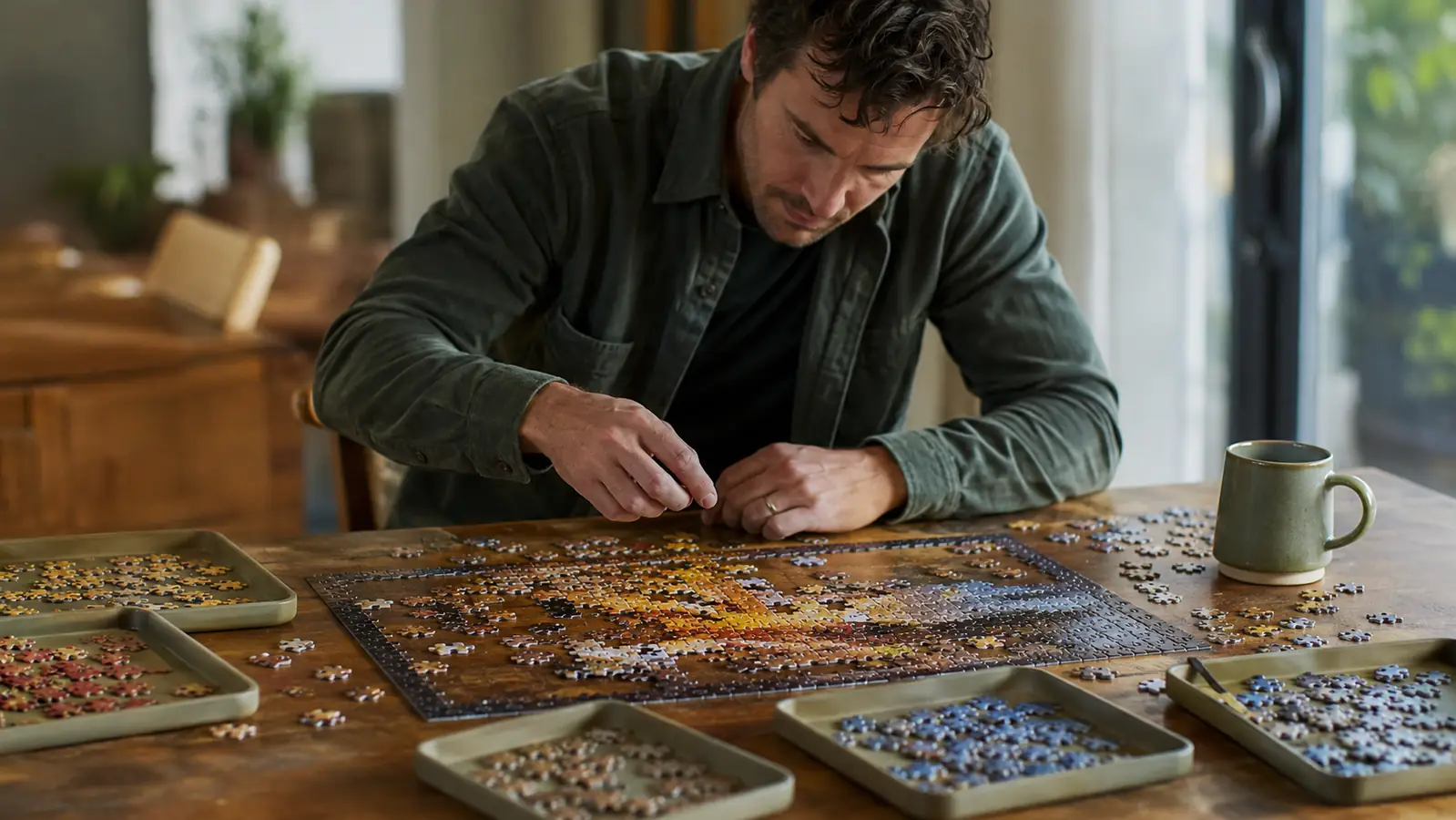
With your edge pieces sorted and your color trays ready, assemble the border. This is the most satisfying part of the puzzle. You are building a frame that will hold everything else. Take your time and make sure each edge piece clicks in properly. A loose border will cause problems later. I check the fit by running a finger along the seam; if anything rocks, I pull that piece and try its neighbor.
Once the frame is done, do not try to fill the whole thing at once. Pick one section and work it until it is complete. I usually start with the tree trunk because it is the most recognizable part of the image. From there, I work outward into the branches and leaves. The PICKFORU Tree of Life has a lot of detail in the branches, which gives you natural stopping points. On the third evening I finished the trunk and the lower branches, and that section alone made the whole puzzle feel half done even though it was maybe a third of the pieces.
Working in small sections is what keeps a 1000-piece puzzle from feeling overwhelming. You are not solving a thousand pieces. You are solving ten sections of a hundred pieces each. That is a much friendlier problem, and it is the reason the method works for beginners and experienced puzzlers alike. I tell the grandkids the same thing when they visit: pick the part of the picture you like best and start there, the rest will follow.
Step 5: Pace yourself and know when to stop
The biggest enemy of a good puzzle session is fatigue. When you start making mistakes, or when you find yourself staring at the same piece for five minutes, stop. Walk away. Make a cup of tea. The puzzle will still be there when you get back, and I promise it will look different when you return with fresh eyes. One night I spent forty minutes trying to place a single leaf piece, went to bed frustrated, and found the correct spot in about ten seconds the next morning.
I set a simple rule for myself: no more than ninety minutes at a stretch. That keeps the puzzle fun and keeps my neck from hurting. Some evenings I only do the border and call it a night. That is a perfectly good session. A 1000-piece puzzle is a marathon, not a sprint, and pacing is what gets you to the finish. I also stop when I have made three mistakes in a row, because that is my signal that my eyes are done even if my brain says otherwise.
The PICKFORU Tree of Life took me about six days, roughly two hours a day. That is a normal pace for a 1000-piece puzzle. If you finish it faster, wonderful. If it takes you two weeks, that is also wonderful. The point is to enjoy the process, not to race through it. The last fifty pieces went fast, and the very last piece was the most satisfying click of the whole week.
What Else Helps
A few tools make the whole process easier. A puzzle board with a felt surface keeps pieces from sliding. A sorting tray set is worth the small investment if you plan to do more than one puzzle. And a good lamp with adjustable brightness makes a real difference on a colorful image like the PICKFORU Tree of Life. I use a cheap desk lamp with a daylight bulb, and it cost less than a takeout dinner.
I also keep a small notebook next to the puzzle table. I jot down which sections I finished and which color zones gave me trouble. It sounds fussy, but it helps me pick up where I left off after a break. And when I gift a puzzle, I write a little note inside the box lid with the same advice: edges first, sort by color, work in sections. The grandkids roll their eyes, but they finish the puzzles. My oldest granddaughter, who is fifteen, actually asked for the PICKFORU Tree of Life for her birthday after she saw mine on the table, and she finished it in nine days.
You are not solving a thousand pieces. You are solving ten sections of a hundred pieces each, and that is a much friendlier problem.
Ready to start your own Tree of Life puzzle?
The PICKFORU Tree of Life is a beautiful, challenging 1000-piece puzzle that rewards the method above. Check today's price on Amazon and see why it is one of my favorite puzzle gifts.
Amazon Check Today's Price on Amazon →