

I have bought a lot of puzzle gifts over the years, and I can tell you exactly where most of them end up. The back of a closet, still in the shrink wrap, by the time the next birthday rolls around. So when I picked up Educational Insights Kanoodle for my six-year-old grandson, I made myself a promise: I would judge it the same way I judge every gift I give, by whether anybody is still playing with it a month later. Six months later, the honest answer is that it gets played with almost every week. And the person who plays with it most is me.
Kanoodle looks almost too simple to bother with. A small case, a dozen plastic pieces, a booklet of puzzles. But simple is not the same as easy, and that is the whole trick. It is the kind of puzzle that makes a retired math teacher sit up a little straighter, and the kind of toy that keeps a six-year-old quiet for twenty minutes at a stretch. That combination is harder to find than you would think.
The Quick Verdict
A small, sturdy, surprisingly deep brain teaser that has earned a permanent spot on my kitchen counter. Buy it for the kid, then be prepared to keep it for yourself.
Amazon Check Today's Price →The puzzle gift that actually got played with
Six months in, Kanoodle is still on my kitchen counter, not in the closet. That puts it ahead of almost every gift I have ever bought. See today's price on Amazon.
Amazon Check Today's Price on Amazon →How I've Used It
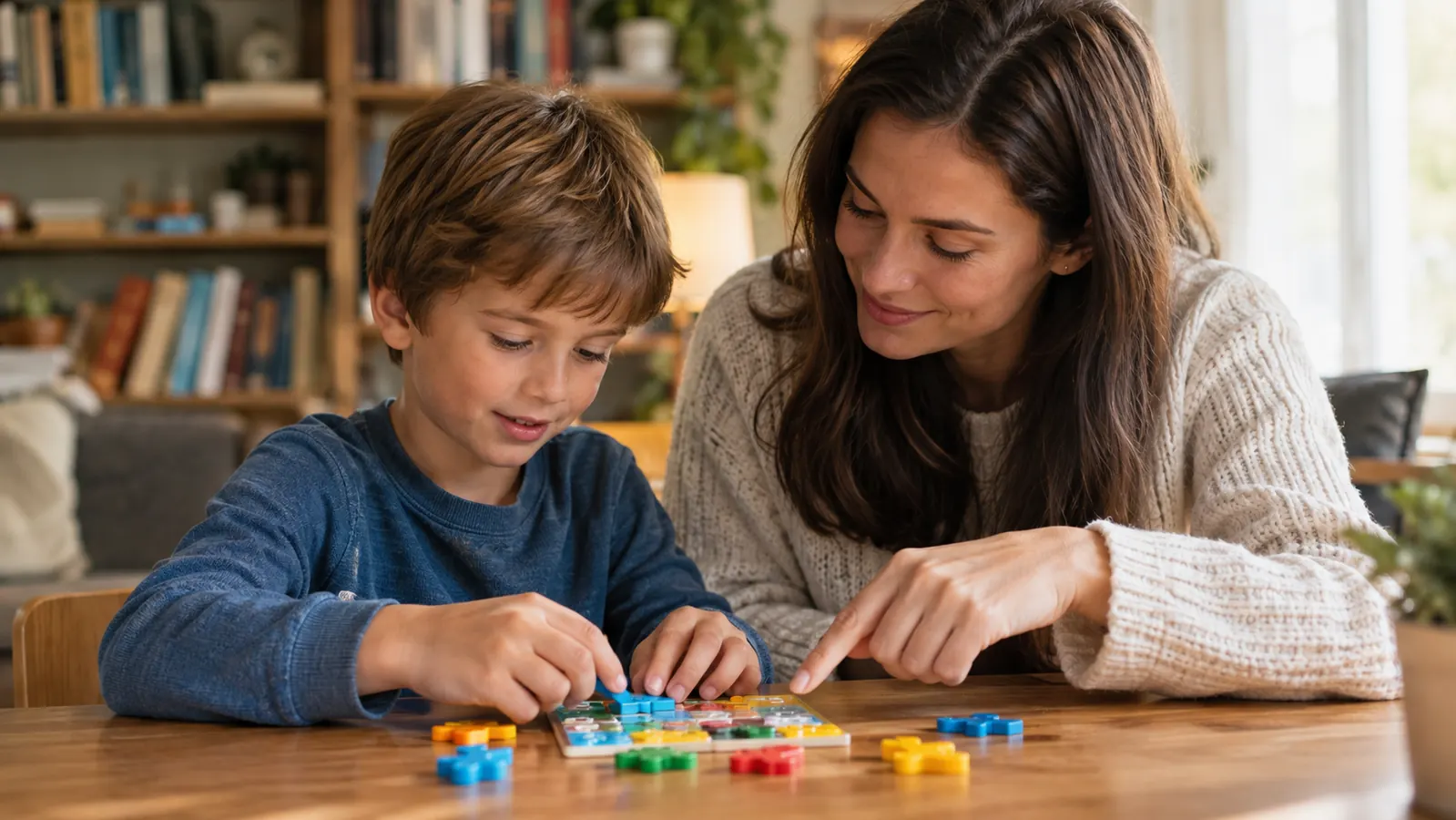
Kanoodle came into our house as a birthday present, but it did not stay in the gift pile for long. My grandson opened it, dumped the twelve pieces onto the kitchen table, and had the first puzzle snapped together before I finished pouring his orange juice. I figured that would be the end of it. Kids lose interest fast. But the next time he came over, he asked for it by name, and that is when I started paying attention.
Since then, it has lived on the kitchen counter, right next to the coffee maker. I do a few puzzles with my morning coffee before the rest of the house wakes up. It comes out during our monthly game night with my book club friends, where it gets passed around the table like a hot potato. And it went with us on the drive to visit our grown kids, because it takes up less room than a paperback and does not need a charger. Gus, who will happily do a crossword but claims he is not a puzzler, has been caught with it twice.
The way I use it has changed over time. In the first month, I worked through the 2D puzzles in order, feeling very clever. By month three, I was stuck on the 3D pyramid puzzles and refusing to put it down. By month six, I had started inventing my own challenges, like building the pyramid blindfolded, which I do not recommend, and timing myself on the beginner layouts. It is rare for a puzzle to hold my attention this long, and I say that as someone who has had a jigsaw on the dining room table for the better part of thirty years.
What You Actually Get in the Box
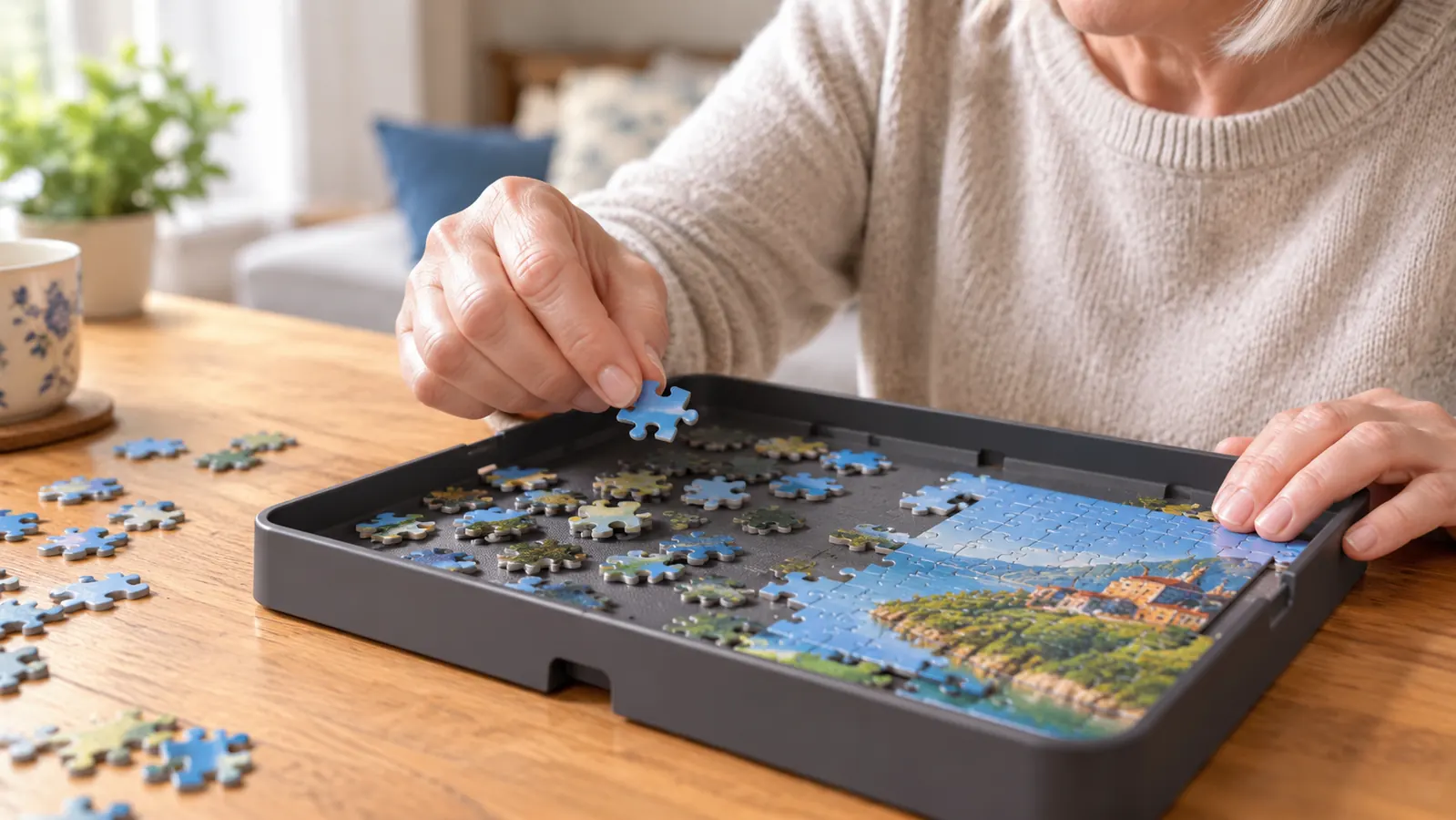
The whole thing is smaller than you expect. The case is about the size of a smartphone, and everything fits inside it: the twelve pieces, the booklet, and the board itself, because the inside of the case doubles as the play surface. That single design decision is the reason this puzzle gets used instead of lost. There is no separate board to misplace and no bag of pieces rattling around the toy bin.
Educational Insights has been making learning toys for a long time, and the quality shows in the details. The pieces are thick, sturdy plastic that snaps together cleanly and holds. The booklet is packed with 200 puzzles, which sounds like a lot until you realize the last page of 3D challenges is genuinely brutal. And the whole thing closes up tight enough to survive being thrown into a beach bag, which is more than I can say for most of the games we own.
The puzzles come in two flavors. The 2D puzzles are played flat on the board, and they range from can-do-in-thirty-seconds to stare-at-the-ceiling-for-ten-minutes. The 3D puzzles are the real test. You are building a pyramid or a staircase out of pieces that do not look like they should fit together, and the only way through is patient trial and error. My grandson calls the 3D ones the grown-up puzzles, which tells you everything about how the difficulty ramps.
The Math Teacher's Take on Why It Works
I taught middle school math for thirty years, so I have strong opinions about what makes a puzzle worth a child's time. The best ones do not look like schoolwork. They sneak the thinking in through the back door. Kanoodle is exactly that. The pieces are asymmetrical, which means every placement has consequences. Move one piece and the whole board changes. That is spatial reasoning, planning, and flexible thinking all wrapped up in a game that a kid experiences as just messing around with plastic pieces.
What impresses me most is how it handles failure. There is no buzzer, no wrong-answer sound, no score at the end. If a layout does not work, you take the pieces apart and try again. That is how real problem solving works, and it is a lesson most toys are too impatient to teach. The booklet even nudges you toward this, because the hard puzzles are not something you solve on the first try. You learn to look at the pieces differently, which is exactly the skill I spent my career trying to build.
It also works across ages in a way I did not expect. My six-year-old grandson can do the beginner 2D puzzles with a little help. My fifteen-year-old granddaughter, who is too cool for most toys, sat down with the pyramid and would not leave it alone until she cracked it. And my book club friends, all of us north of sixty, have spent entire game nights passing it around. How many products can you say that about? Not many.
Six Months In: How It Holds Up
Here is the durability report, because I know that is what you actually want to hear. After six months of near-daily use, the pieces still fit together snugly. The case still latches. The booklet is a little dog-eared, which I consider a good sign, and the puzzles are all still readable. Nothing has chipped, cracked, or warped, and we have not lost a single piece, which is saying something given how many bags this thing has been tossed into.
The honest downsides are real, so let me name them. The booklet is small, and the puzzles are numbered but not sorted by difficulty, so you cannot tell which ones are warm-ups and which ones will eat your afternoon. The 3D puzzles are hard enough that younger kids will need an adult nearby, which is fine at our house but worth knowing before you hand it to a wiggly six-year-old. And this is a solo puzzle first. It is wonderful as a pass-around activity, but it is not a competitive game, so if you are looking for something for family game night, this is not that.
The other thing I will tell you honestly is that the difficulty curve is not gentle. The booklet starts easy and then gets steep fast. I watched my grandson go from flying through the beginner puzzles to getting genuinely frustrated on the intermediate ones, and we had to have a little talk about how getting stuck is part of the fun. Once he understood that, he started treating the hard puzzles like a challenge instead of a failure. That is a parenting win, and also a pretty good argument for why this toy is worth the shelf space.
How It Stacks Up Against My Other Puzzles
I have a whole shelf of brain teasers, so I did not take Kanoodle's word for it. Compared to my sudoku books, it is harder to put down, because there is a physical piece to move and a physical board to fill. Sudoku is wonderful for focus, and I still do one most mornings, but it does not ask you to rotate shapes in your head the way Kanoodle does. If you want the detailed breakdown, there is a separate article on this site that compares the two head to head.
Compared to jigsaw puzzles, it is faster and more portable. A jigsaw takes over my dining room table for a week, and I love that, but I cannot take it to the dentist's office. Kanoodle fits in a coat pocket. Compared to the brain game apps on my phone, it has the enormous advantage of not being on my phone. When I do Kanoodle, I am not also checking email. That alone has made it my default morning puzzle.
It has also changed how I think about gifts. I used to buy the big, impressive-looking games, the ones with the giant boxes and the fancy components. Kanoodle taught me that the best gifts are often the small ones that fit in a stocking and do not need batteries. If you are looking for more ideas along those lines, the site has a list of brain games for adults that keep your mind sharp, and it is worth a read before you shop.
What I'd Tell a Gift Shopper
If you are shopping for a puzzle lover, here is my advice in one sentence: buy the small puzzle, not the big one. Kanoodle is inexpensive, which means it is an easy yes, and it is small, which means it fits in a stocking, a gift bag, or a suitcase. It does not need batteries, it does not make noise, and it does not require a table the size of a pool table. It is the kind of gift that looks almost too plain to be exciting, and then it turns out to be the thing everybody picks up.
The age range on the box says seven and up, and I would say that is about right, with a caveat. A patient six-year-old can handle the beginner puzzles, especially with an adult nearby. A ten-year-old can handle most of the 2D puzzles on their own. And adults will find plenty to chew on in the 3D section. I have given this as a birthday gift, a holiday gift, and a just-because gift, and it has gone over well every single time. That is a better track record than any other puzzle I have bought.
One more thing. If you are buying it for a child, buy one for yourself too, because you are going to want to play with it. I speak from experience. I have already bought two more as gifts since the first one landed on my kitchen counter, and Educational Insights has earned a permanent place on my gift list. My grandson and I now have an unofficial competition going, and I will not tell you who is winning. The story of how this little puzzle became the most fought-over item at our house is on this site if you want the full picture.
What I Liked
- The twelve pieces are thick, sturdy plastic that still fits together perfectly after six months of daily use.
- 200 puzzles in one small case, from thirty-second warm-ups to 3D challenges that will eat your whole afternoon.
- The case doubles as the play board, so it travels in a coat pocket and nothing gets lost.
- Works for ages six to sixty-plus, solo or as a pass-around at a table.
- No batteries, no screen, no noise, and no setup. Open the case and you are already playing.
Where It Falls Short
- The booklet numbers the puzzles but does not sort them by difficulty, so you cannot tell which ones are warm-ups.
- It is a solo puzzle first. Great for passing around, but not a competitive family game.
- The 3D puzzles are genuinely hard, and younger kids will need an adult nearby.
- Lose one piece and the whole set is done, so it is not for careless bags.
Six months later, the same twelve pieces are still on my kitchen counter, and I still have not finished the last page of the puzzle book. That is the highest compliment I can pay a brain teaser.
Who This Is For
Buy this for the person who likes to keep their hands busy while they think. The kid who finishes homework early and needs something to do. The adult who does sudoku on the bus. The grandparent who has a jigsaw going at all times and wants something that fits on the arm of a chair. The traveler who needs a carry-on-friendly brain workout. It is also a genuinely good gift for people who say they do not like puzzles, because the bar for entry is so low. You just pick up a piece and see where it fits.
It is especially good for the six-to-twelve crowd, which is a hard age range to shop for. Too many toys in that range are either babyish or boring. Kanoodle hits the sweet spot: it looks like a toy, but it plays like a challenge. And because there are 200 puzzles in the book, it does not get exhausted in an afternoon the way most toys do.
Who Should Skip It
This is not the puzzle for you if you hate trial and error. There is no strategy guide that will save you here, and no trick to memorize. The hard puzzles are solved by trying things, failing, and trying again, and if that sounds like your personal version of a bad time, you will not enjoy this. It is also not a group game. If you want something for competitive family game night, with winners and losers and a little trash talk, get a board game instead.
And a few practical notes. If you are shopping for a child under six, the pieces are small enough that I would not hand them over unsupervised. If you are the kind of person who loses one small piece and then the whole set is ruined, this will test you. And if you are looking for a puzzle that you can solve in one sitting and then put away forever, this is the wrong shape of product. Kanoodle rewards the long haul. That is exactly why it is still on my counter, but I know it is not for everybody.
The gift that does not end up in the closet
Six months of real use, and Kanoodle is still the first thing picked up at our house. If you are shopping for a puzzle lover, a grandkid, or just yourself, this is the easiest recommendation I have. Check today's price on Amazon.
Amazon Check Today's Price on Amazon →