
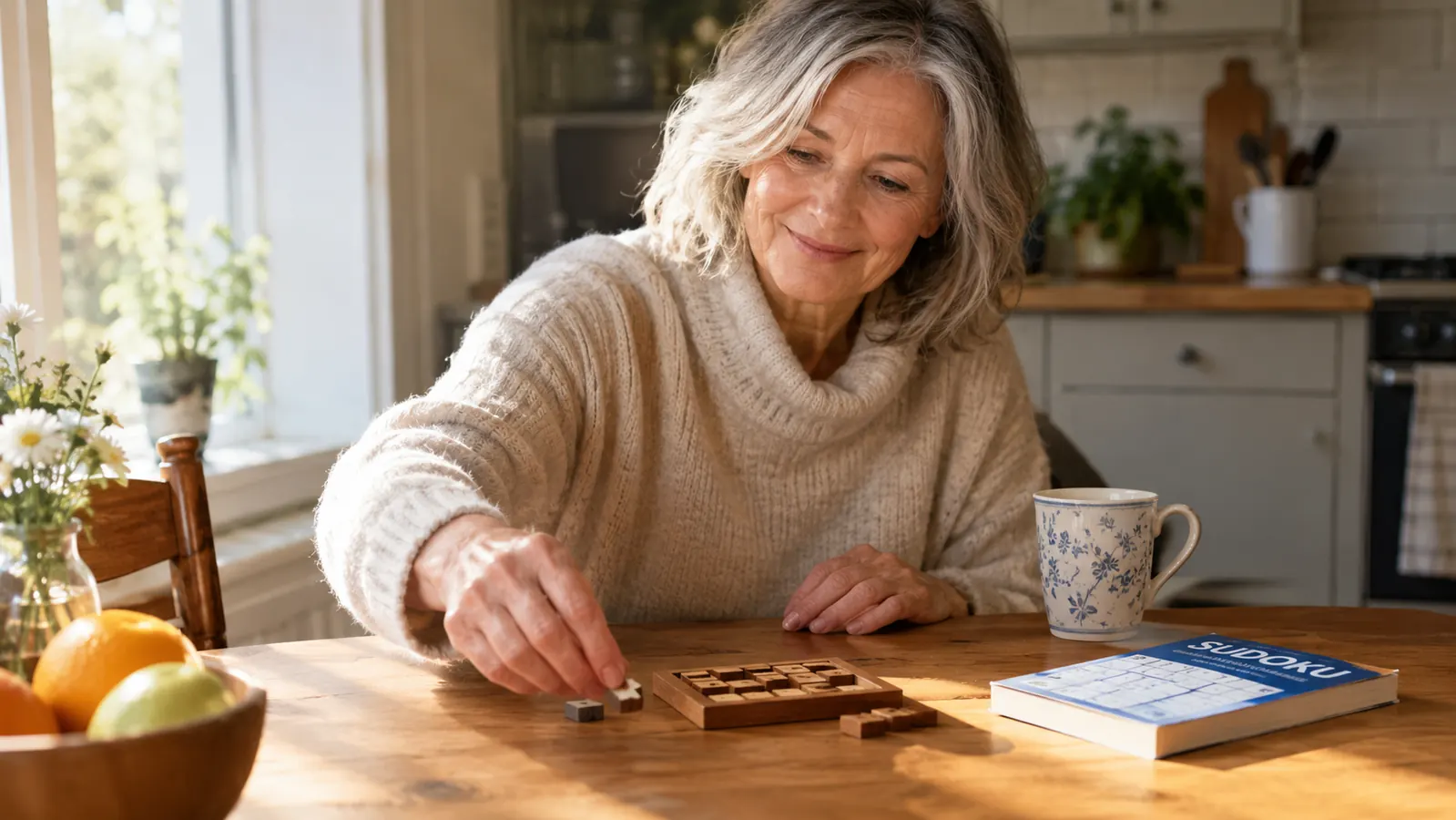
If you are trying to decide between Kanoodle and a sudoku book, here is the short answer: Kanoodle is the one that will still be on your coffee table in a month. A sudoku book is the one you will leave in the car, feel guilty about, and finally give to the library sale. That is not because sudoku is bad. It is because the two puzzles ask different things from you, and most of us only have the attention for one of them at a time.
I am Roz, a retired middle school math teacher, and I have spent my whole life with both kinds of puzzles. I did sudoku on my lunch break for years. I also gave Educational Insights Kanoodle to two of my grandkids last Christmas, and then borrowed it back so often that I bought my own. This comparison comes from the two months after Christmas, keeping both on my dining room table and honestly tracking which one I reached for.
To keep myself honest, I kept a spiral notebook in the kitchen drawer, the same kind I used to hand out detention slips with. Every time I sat down to puzzle, I wrote the date, which one I picked, and how long I stayed. I tried a strict schedule at first, sudoku on Mondays, Wednesdays, and Fridays, Kanoodle on the other days. That lasted exactly four days. On the fifth day, I skipped both because I was packing for a weekend trip, and the schedule died right there. So I changed the rule: pick whichever one you actually want, and write it down. No guilt, no quotas. The first week was a tie, mostly because the sudoku book was new and I was curious. The second week, I reached for Kanoodle four times and the sudoku book twice. By the third week, the sudoku book had migrated to the passenger seat of the car, and I was doing Kanoodle with my morning coffee instead of the crossword. I even dated every entry, which sounds like overkill, but it is how I know the sudoku book sat untouched for nine straight days in late January.
The thing that surprised me was not that I preferred Kanoodle. It was how fast the preference showed up once I stopped pretending I would use both equally. Somewhere around the fourth week, I caught Gus, who will tell you he is not a puzzler, sitting at the table with the Kanoodle, trying to make a pyramid out of the pieces. He claimed he was just tidying up. I did not say a word. I just wrote in the notebook: Gus, Kanoodle, eleven minutes. That is the moment I knew this comparison had an answer, and it was not the one I expected when I started. The notebook is still in the drawer, and every now and then I add a line to it. Gus will deny this story, by the way, but the notebook does not lie.
| Kanoodle | Sudoku Books | |
|---|---|---|
| What it exercises | Spatial reasoning, planning, and the kind of trial-and-error thinking that builds on itself | Logic, pattern recognition, and number placement |
| Replay value | Over two million possible puzzle layouts in a single portable board, so it rarely feels like a repeat | A book has a fixed number of grids, and once you finish them, you either buy another book or start over |
| Portability | Fits in a coat pocket, no pencil needed, works in the car or on a plane | Requires a pencil and an eraser, awkward on a lap, easy to lose your place |
| Cost over time | One purchase, and the puzzles regenerate forever | A book is cheap, but you keep needing the next one |
| Satisfaction of finishing | A completed 2D puzzle gives a quick, visual win | A finished sudoku grid gives a clean, satisfying sense of closure |
| Best for | People who like to fidget, think with their hands, and want a puzzle that travels | People who like quiet, orderly logic and do not mind keeping a pencil handy |
Where Kanoodle Wins
Kanoodle wins on the thing that actually matters for a puzzle: you will keep playing it. A sudoku book has a beginning, a middle, and an end. Kanoodle has a beginning and then a very long middle that never quite ends. The box says there are two million possible puzzles, and while I have not personally verified that number with a calculator, I can tell you that in two months I never once hit a layout I recognized. Every time I sat down with it, my brain had to build a new map.
It also wins on portability, and that matters more than you think. A sudoku book needs a flat surface, a pencil, and a good eraser. Kanoodle needs a lap. I have done Kanoodle puzzles on a park bench, in the waiting room at the dentist, and on the passenger seat while my husband Gus ran into the post office. The pieces are chunky enough that you can feel them click into place, and the whole thing is small enough to disappear into a coat pocket. For anyone who likes to puzzle with their hands, that is a huge advantage.
The other thing I did not expect is how much the difficulty curve keeps you coming back. The booklet that comes in the box starts with puzzles a six-year-old can do, and my six-year-old granddaughter really can do them, which is its own kind of magic. But the puzzles on the last page, the ones marked expert, are genuinely hard. One Saturday morning in February, I sat down with a layout that looked like a sideways staircase and worked on it for twenty-two minutes before I got it. I wrote the time in my notebook because I could not believe it. When I finished, I actually clapped, alone, at my own kitchen table. A sudoku book has never made me clap. It has made me nod, and once it made me sigh with relief, but it has never made me clap. And the board closes up tight enough that I have carried a half-finished puzzle from the dining room out to the porch without losing my place. The expert layouts look impossible when you first dump the pieces out, and then one piece clicks, and then another, and suddenly the whole shape appears like a picture developing.
There is also the 3D section in the booklet, where the pieces stack into pyramids and cubes instead of lying flat. I tried my first 3D puzzle on a Sunday afternoon, and it fell apart in my hands when I was one piece away from done. I set it aside, came back the next morning, and got it on the second try. That failure is the whole reason I kept going back. With sudoku, when you are stuck, you stare at the grid and feel dumb. With Kanoodle, when you are stuck, you pick the pieces up, turn them around, and try again, and the trying feels like playing. For someone like me, who spent thirty years teaching middle schoolers that a wrong answer is just a first draft, that is a big difference. I have since done all six of the 3D puzzles in the booklet, and the pyramid is still my favorite because it is the one I failed first.
The puzzle that actually gets played with
If you are shopping for a puzzle lover, or you are the puzzle lover, Educational Insights Kanoodle is the one that earns its spot on the table. Check today's price on Amazon.
Amazon Check Today's Price on Amazon →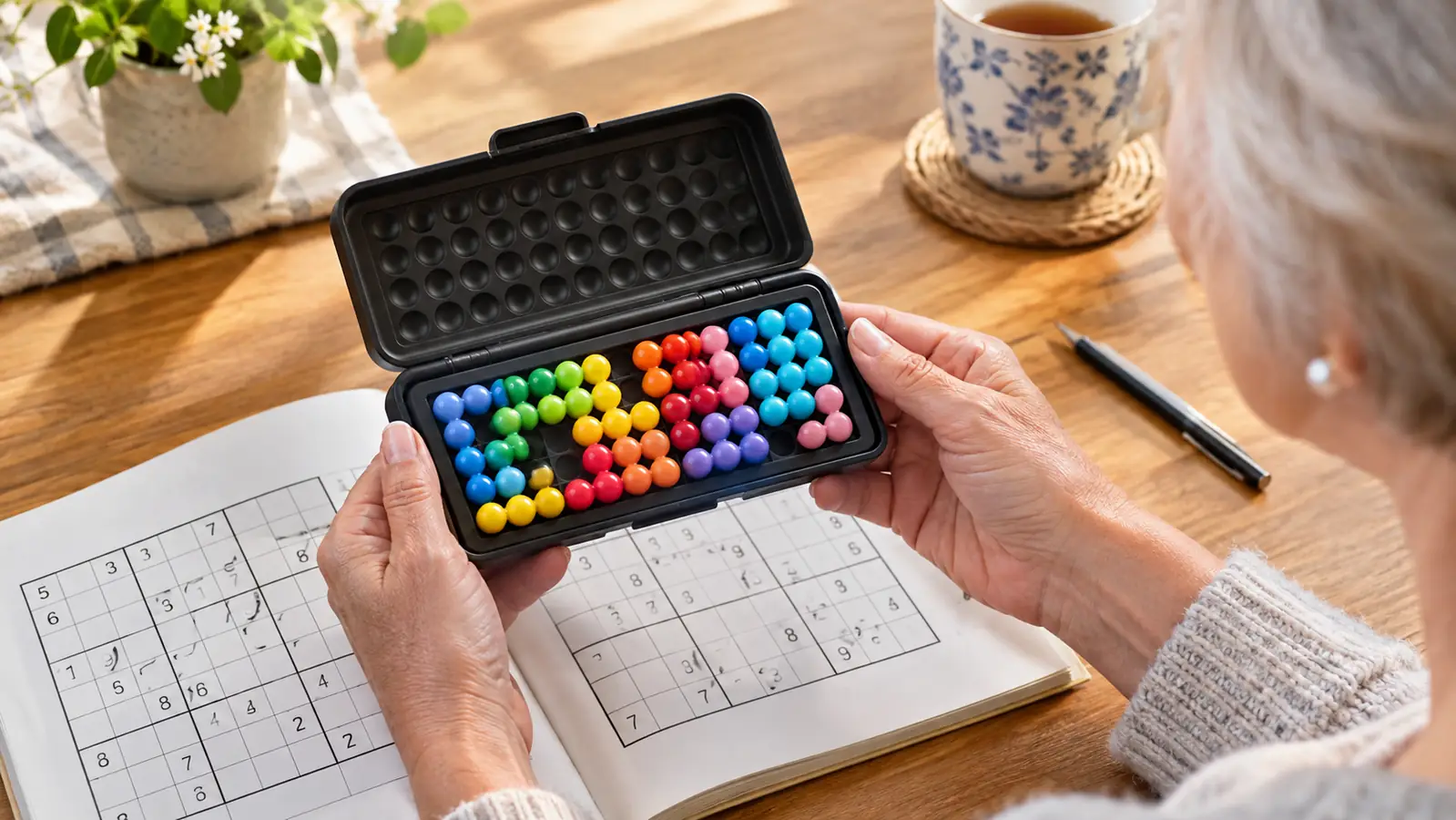
Where Sudoku Books Win
Let me be fair to the sudoku book, because it does win a real category. A finished sudoku grid is deeply satisfying in a way that a Kanoodle solve is not. When you complete a Kanoodle puzzle, the win is visual and quick: the pieces fit, you see the shape, you move on. When you complete a hard sudoku grid, you have spent twenty minutes building a web of logic, and the moment you write that final number, you feel a quiet sense of closure that is hard to beat.
Sudoku also wins for a specific kind of person: the one who wants a puzzle they can do in a waiting room without looking like they are playing. There is something meditative about sudoku that Kanoodle does not offer. You are not fidgeting with pieces. You are just moving numbers around in your head, and for a lot of people, that is exactly the point. My friend Diane from book club will happily do sudoku for an hour while the rest of us are still arguing about the first clue in a Kanoodle puzzle.
I want to be fair about the meditative thing, because it is real. The Sunday before New Year's, I made a pot of coffee, sat down at the dining room table, and did a hard sudoku from start to finish. It took me nineteen minutes, and for those nineteen minutes, nothing else existed. No list of errands, no mental argument with the school district about my pension, just a grid of numbers resolving itself. That kind of focused quiet is harder to find in Kanoodle, because Kanoodle rewards fidgeting and sudden inspiration, and sudden inspiration is not quiet. It is the difference between walking and dancing. Both get you there, but one of them lets you think. And there is a small ceremony to sudoku that I have come to appreciate: a good pencil, a clean eraser, and the particular satisfaction of fixing a wrong number without tearing the paper. My friend Diane says sudoku is the only puzzle that lets her think and listen to an audiobook at the same time, and I believe her.
Sudoku is also the better choice if you like to puzzle in bed at night. I have tried Kanoodle lying down exactly once, and the pieces slid off the board and under the bed, and Gus had to retrieve three of them with a yardstick. A sudoku book never slides anywhere. It just sits on your chest while you work, and when you fall asleep mid-puzzle, the pencil mark is still there in the morning. The book I used was a cheap paperback with 300 grids, and I finished 41 of them in those two months before I stopped keeping count. And if you are the kind of person who likes to finish what you start, a sudoku book gives you a clean stopping point. Every grid has an ending, and the ending always comes. With Kanoodle, the ending is wherever you decide to stop, and some people find that exhausting instead of liberating.
Who Should Buy Which
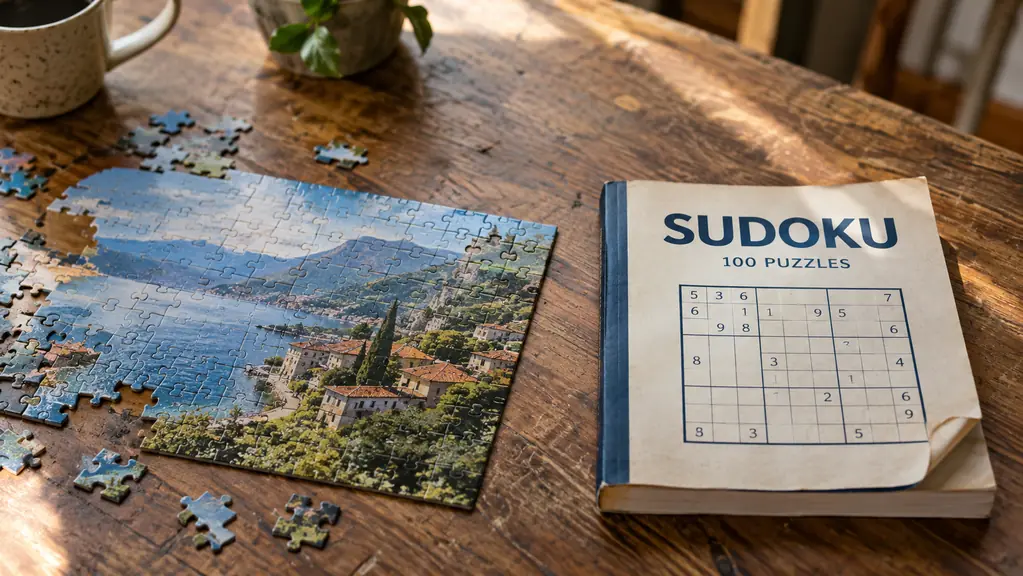
Buy Kanoodle if you want a gift that will still be getting played with a month later. That is my personal test for any puzzle gift, and Kanoodle is one of the few that passes it. It is ideal for a grandkid who likes to fidget, a friend who travels, or anyone who needs a screen-free way to keep their hands and brain busy. It is also the better choice if you are buying for a household, because one small board can be passed around a table and everyone can take a turn.
Buy a sudoku book if you are buying for a person who specifically loves sudoku, or for yourself if you already know you prefer number puzzles. There is nothing wrong with that preference. But if you are standing in the aisle trying to decide which one to wrap, go with Kanoodle. A sudoku book is a nice gift for someone who already plays sudoku. Kanoodle is a nice gift for someone who does not know yet that they love spatial puzzles, and that is a much bigger gift to give.
Let me tell you what happened with the two I gave last Christmas, because that is the real data. I gave Educational Insights Kanoodle to the two grandkids who are hardest to buy for, the ones who already have every screen and every toy. On Christmas afternoon, one of them sat on the floor with it for a solid hour, trying to make the pyramid, and would not let anyone else touch it. A month later, when I called to ask what they had actually played with, that same boy said Kanoodle, and his mother said he kept it on his nightstand and did it before bed. The other grandkid liked it fine, but she is a reader, and by February she had gone back to her chapter books. Her brother is the one who still asks me for a harder puzzle every birthday, which tells me the Kanoodle did its job.
So the honest answer is that both are good gifts, but they are good for different people. Kanoodle is the safer bet when you do not know the person well, because it does not assume they already like number puzzles. It assumes they have hands and a brain, which is a safe assumption for almost everyone over the age of five. A sudoku book is the better bet when you know the person is already a sudoku player, because a sudoku player can always use another book and will not be offended by a cheap one. My rule of thumb for gift giving is simple: if I can picture the person doing the puzzle in a waiting room, I buy the book. If I can picture them doing it at the kitchen table while dinner simmers, I buy the Kanoodle. That rule has never failed me, and I have been buying puzzle gifts for thirty years. And for the adults on your list, the ones who say they have everything, Kanoodle is a small enough gift that it does not feel like a production, which means it actually gets opened and tried.
Still not sure? This is the one I would wrap
Educational Insights Kanoodle is my pick for a gift that stays out of the closet. Check today's price on Amazon and see if it fits your person.
Amazon Check Today's Price on Amazon →