
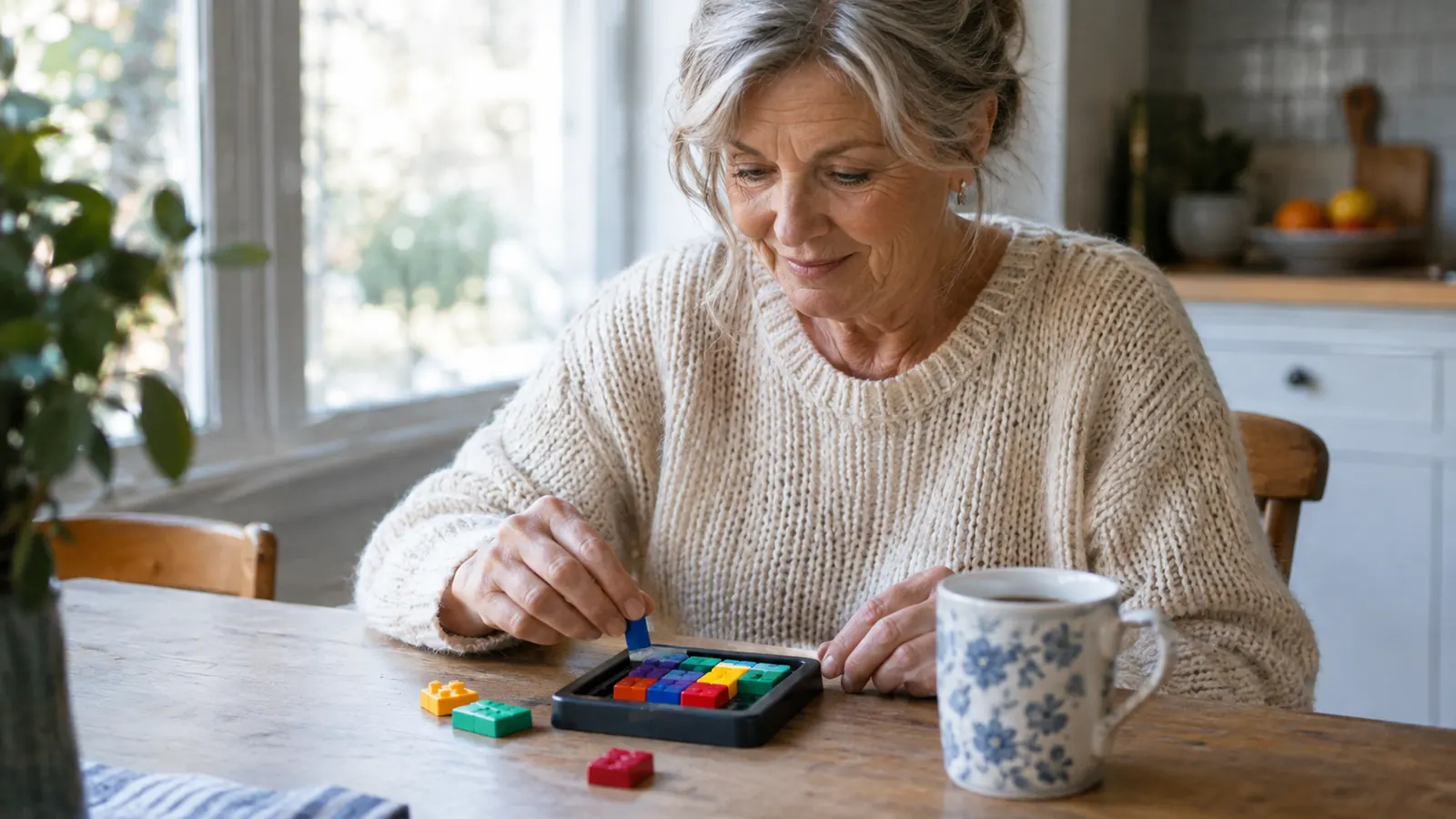
I have bought a lot of puzzle gifts over the years, and I have learned to be honest with myself about which ones actually get played with a month later. Kanoodle from Educational Insights is one of the most popular brain teaser games on the market, with over 35,000 ratings and a 4.7 star average. So when I finally sat down with it myself, I wanted to know the truth: is this a toy that earns its place on the shelf, or is it another gift that gets played once and forgotten? The answer, as with most things, is complicated.
I am Roz, a retired middle school math teacher, and I have been a puzzler my whole life. There is always a jigsaw in progress on my dining room table, and I do brain teasers with my morning coffee. I also buy a lot of games for my five grandkids, ages 6 to 15, and I judge every gift by one standard: is it still being played with a month from now? Kanoodle has been through that test in my house, and I want to tell you exactly what happened, who loved it, who got bored, and who should probably skip it.
The Quick Verdict
Kanoodle is a genuinely clever spatial reasoning puzzle that earns its reputation, but it is not for everyone. It suits patient, visual thinkers and makes a great travel gift. It will frustrate people who want a social game or who give up quickly when a puzzle does not solve itself in a minute.
Amazon Check Today's Price →Want the honest scoop before you buy?
I have tested Kanoodle with grandkids, friends, and my own morning coffee. Here is what I found, including who should skip it.
Amazon Check Today's Price on Amazon →How I Have Used It
I have had Kanoodle for a little over a year now. I bought mine on a Tuesday last fall, the day after my book club meeting, and I remember that detail because I solved the first puzzle before my coffee was done. I keep it in the living room, on the shelf next to the jigsaw table, and I have used it in three different settings: by myself with coffee, with my grandkids when they visit, and at my monthly game night with friends from my book club. That range of settings matters, because a puzzle that only works solo is a different product from one that works as a group activity.
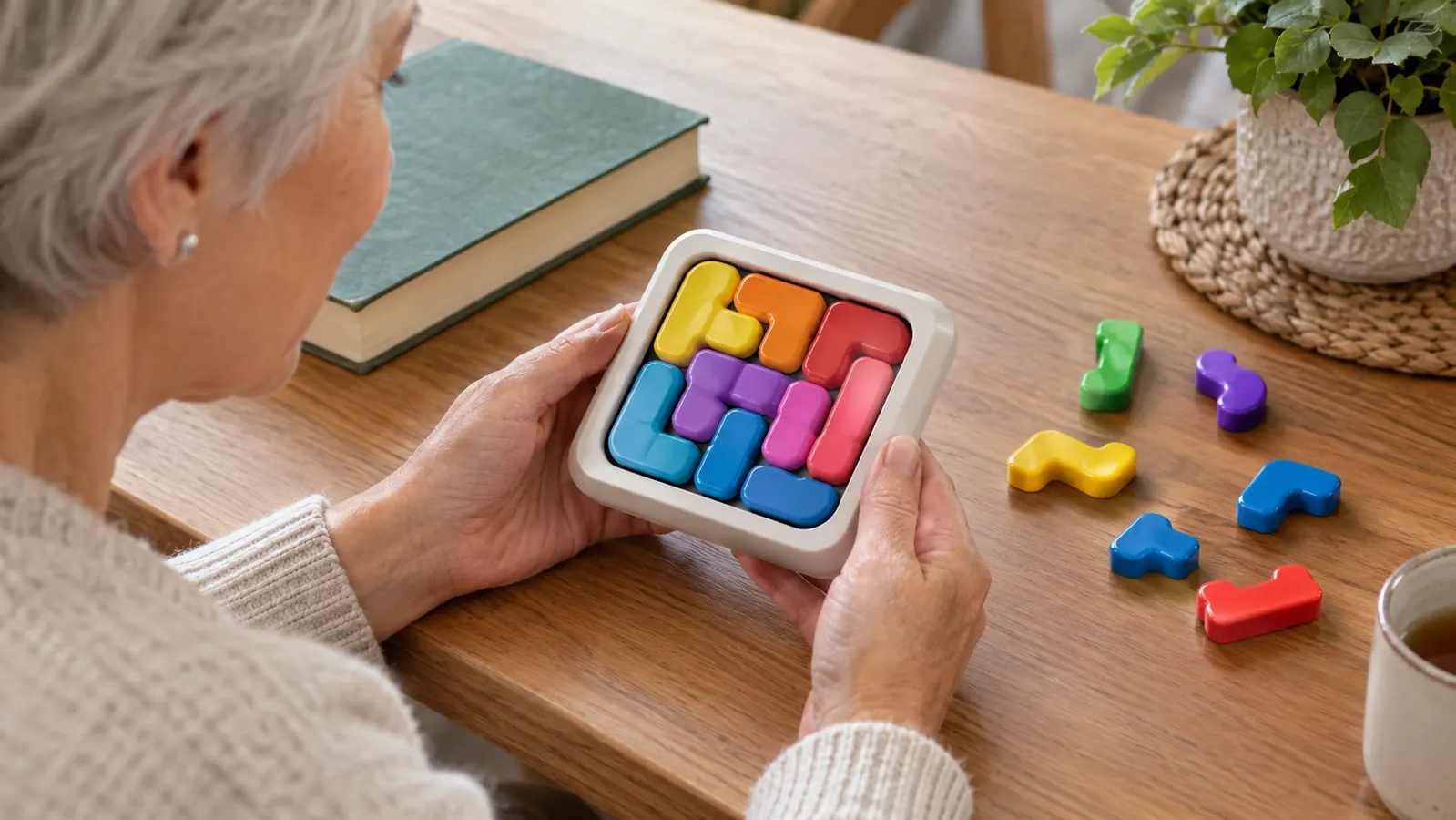
The game itself is simple to understand. You get 12 colorful pieces, each made of small spheres connected in different shapes. Educational Insights includes a booklet with hundreds of puzzle challenges, and the case is smaller than a paperback book, about four and a half inches across, fitting in the palm of my hand. The 2D puzzles ask you to fill a triangular grid with the pieces. The 3D puzzles ask you to build a pyramid. The rules fit on one page, which is exactly how I like my puzzles: the challenge should come from the solving, not from deciphering the instructions.
I started with the beginner 2D puzzles and worked my way up. The early ones took me maybe a minute each. The intermediate ones took a few minutes. The expert ones, I will be honest, took me a good while, and a few of them I set aside and came back to the next day. Puzzle 47 in the booklet took me the better part of an evening, and I felt genuinely proud when I finally fit the last piece. That progression is the heart of what makes Kanoodle work. It meets you where you are and then pushes you.
What Nobody Tells You About Kanoodle
Here is the thing that surprised me most: Kanoodle is not a game you play with other people. It is a puzzle you solve alone. My game night friends each wanted to try it, but we quickly realized that only one person can really work a puzzle at a time. It became a pass-it-around activity, with everyone watching one person think. At our October game night, my friend Linda spent fifteen minutes on one puzzle while the rest of us just watched. That is fine for a few minutes, but it is not a group game in the way a card game or a board game is.
The second thing nobody tells you is that the difficulty curve is real. The booklet starts gentle, but the expert puzzles are genuinely hard. I watched my 15 year old grandson, who is a sharp kid, get stuck on an expert puzzle for a solid twenty minutes. He eventually solved it, and the look on his face was worth the whole purchase. But I also watched my 9 year old granddaughter get frustrated with the same puzzle and set it aside. I tried the 3D pyramid first myself and failed badly, so I went back to the 2D grids and worked forward from there. That is the right way to approach this puzzle: earn the hard stuff.
The third thing is the pieces. They are small. Each piece is made of little spheres, and they are easy to lose. I keep mine in the included storage case, and I have learned to count the pieces before I put it away. I have already had one close call: a piece slipped under the sofa cushion during a visit, and I spent ten minutes fishing it out. I now keep the case in a drawer, not on the coffee table. If you are buying this for a child who loses things, or for a family that takes games on car trips, you need to know that the pieces will wander. That is not a dealbreaker, but it is a real thing to plan for.
Kanoodle does not care how old you are. It cares about how your brain handles spatial problems.
Who This Is For
Kanoodle suits people who like to think with their hands. If you are the kind of person who does sudoku on your phone, who likes jigsaw puzzles, who enjoys a good logic problem, you will probably like Kanoodle. It is especially good for visual thinkers, people who can look at a shape and imagine how it rotates in space. My husband Gus, who is not a puzzler and will only do a crossword if the mood strikes him, actually enjoyed the beginner puzzles. One Sunday afternoon in November, he sat down with the booklet and worked through the first eight challenges in about half an hour. He did not go near the expert ones, but he sat with me for twenty minutes that evening working through the early challenges.
It also suits travelers. The whole thing fits in a small case, smaller than a paperback book, and it is quiet. I took it to a dentist appointment on a rainy Thursday and solved nine puzzles in the waiting room. I have seen people use it on planes. If you want a gift for someone who travels a lot, someone who likes to keep their hands busy, Kanoodle is a strong choice.
And it suits gift givers who want something that lasts. The puzzles are not consumable. You do not finish Kanoodle the way you finish a workbook. There are hundreds of challenges, and even after a year I have not come close to solving them all. That is a lot of value for the price, and it is why I think it earns a place on the shelf rather than in the closet.
Who Should Skip It
Here is the honest part. Kanoodle is not for everyone, and I think the marketing does not say that clearly enough. If you are buying a gift for someone who does not like puzzles, who gets frustrated easily, or who expects a game to be social, this is probably not the right choice. My 9 year old granddaughter, who loves imaginative play and stories, played with it for about ten minutes one afternoon and then went back to her dolls. That is not a failure of the toy. It is a mismatch between the toy and the kid.
I would also skip it for very young children. The pieces are small, and while the box says it is for ages 7 and up, I would not hand it to a 5 year old without supervision. The small pieces are a choking hazard, and the puzzles require a level of patience that most young kids do not have yet. If you are shopping for a preschooler, look for something chunkier and more forgiving. I learned that lesson the hard way when I brought Kanoodle to a family gathering and the 6 year old immediately put a piece in his mouth. Nothing bad happened, but it reminded me that this is a thinking toy for older kids, not a toddler toy.
And I would skip it if you are looking for a family game night activity. Kanoodle is a solo puzzle. It does not create the laughter and conversation that a good board game does. If your goal is to get the whole family around a table together, buy a card game instead. If your goal is to give one person a quiet, satisfying mental challenge, Kanoodle is excellent.
How It Compares to What I Expected
I went into this expecting a gimmick, honestly. There are so many brain teaser toys on the market, and most of them are thin. You play with them once, figure out the trick, and never touch them again. Kanoodle is not that. The puzzles are genuinely varied, and the progression from beginner to expert is well designed. I have solved maybe forty of the challenges, and I still have hundreds to go. That is rare in this category. I keep a small notebook with the date and puzzle number for each one I finish, and looking back, I can see my solve times getting shorter. That kind of visible progress is what keeps me coming back.
The build quality is also better than I expected. The pieces are sturdy plastic, and they snap together and apart cleanly. The booklet is clear and well organized. The storage case is simple but functional. Nothing about it feels cheap, which matters to me because I have bought enough flimsy toys to know the difference. I have dropped the case on the floor twice, and not a single piece has cracked.
The one thing I would change is the lack of a way to track progress. The booklet has hundreds of puzzles, but there is no marker system, no way to check off what you have solved. I have been keeping my own list on a scrap of paper, which is fine for me, but a more organized person might wish the booklet had a built in tracker. It is a small thing, but it is the kind of small thing that separates a good product from a great one.
What the Grandkids Thought
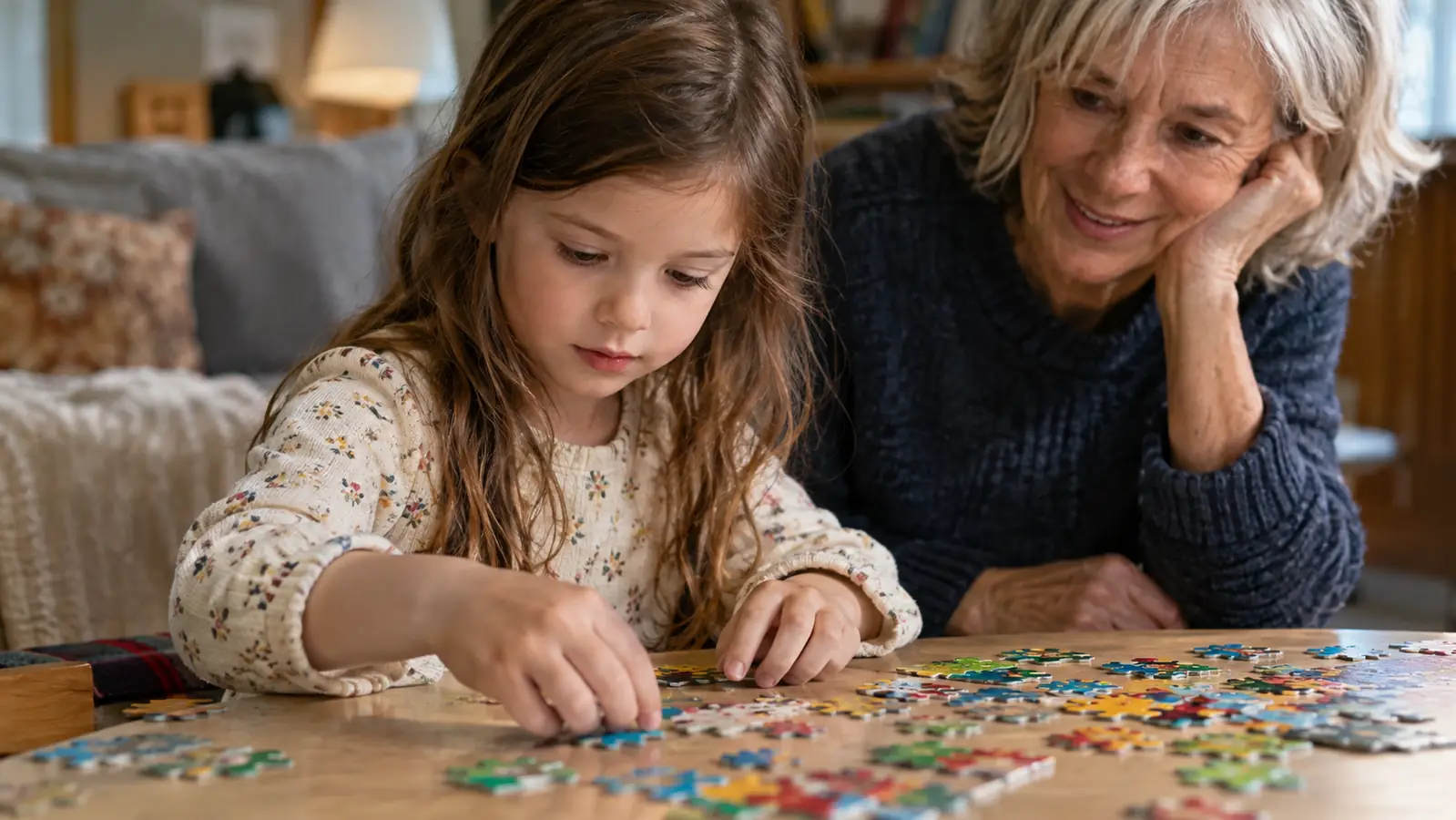
I tested Kanoodle with four of my five grandkids, and the results were honestly mixed. The Saturday before Thanksgiving, all four of them were here at once, and I put the case on the coffee table to see what would happen. My 15 year old grandson loved it. He is a video game kid, but he sat with Kanoodle for a full afternoon, working through the expert puzzles and muttering to himself. He solved puzzle 63 in under ten minutes and asked to borrow it, which is the highest compliment a gift can get in my house. My 12 year old granddaughter liked it too, but she preferred the 2D puzzles and did not have much patience for the 3D pyramid.
My 9 year old granddaughter was the one who surprised me. She is bright, but she is not a spatial thinker. She got frustrated quickly and put it down after about ten minutes. My 6 year old grandson was too young for it entirely. He liked the colorful pieces, but he could not grasp the puzzle structure, and I kept a close eye on him because the pieces are small enough to worry me. I ended up moving the case to a higher shelf after that visit.
The lesson I took from that is simple: Kanoodle is a gift for a specific kind of kid. If you know a child who loves puzzles, who likes to figure things out, who can sit with a challenge for more than five minutes, this is a wonderful gift. If you are buying for a child who prefers stories or physical play, keep looking. There is no shame in that. Not every toy is for every kid.
The Bottom Line
Kanoodle from Educational Insights is a genuinely good puzzle, and I recommend it with one big caveat: know who you are buying it for. It is a solo activity, it requires patience, and it rewards spatial thinkers. For the right person, it is hours of quiet satisfaction. For the wrong person, it is a box that sits on a shelf. I have seen both outcomes in my own house, and I think that honesty is exactly what a gift shopper needs.
If you are shopping for a puzzle lover, a traveler, or a kid who likes a challenge, Kanoodle is worth your money. If you are shopping for a social game or a gift for a young child, keep looking. And if you are shopping for yourself, the way I did, I think you already know whether this is for you. You are the kind of person who reads a 2,000 word review of a puzzle game. You are exactly who Kanoodle is for.
What I Liked
- Genuinely varied puzzles with a real difficulty curve
- Compact and quiet, perfect for travel and waiting rooms
- Sturdy pieces and a simple, clear booklet
- Hundreds of challenges, so it lasts a long time
- Works for a wide age range, from sharp kids to adults
Where It Falls Short
- Strictly a solo activity, not a group game
- Small pieces are easy to lose and a concern for young kids
- Expert puzzles can frustrate people who give up quickly
- No built in progress tracker in the booklet
Still deciding? Here is my honest advice.
Kanoodle is a great gift for the right person. If that sounds like someone you know, check today's price on Amazon and put it at the top of your gift list.
Amazon Check Today's Price on Amazon →